Wednesday, November 25, 2020

Foundry 28mm early-WW2 German Infantry Platoon

In preparation for Conscript Frederick's planned "Assault on the Danzig Post Office" game, I've painted some Foundry models that had been sitting in the lead pile here at Conscript Towers for some time.

Foundry had a brief flirtation with WW2 subjects some time ago and I think I've bought and painted the great majority of models they produced... they made British Home Guard (check), Paratroopers (check), Chindits, and Commandos (check) and some French partisans (check), as well as German Fallschirmjaeger (check) and these humble Heer infantrymen. OK, so I don't have any Chindits... sue me.

The sculpts are just excellent, in my opinion. Nothing over-the-top or outlandish, just basic early war troops. The only criticism I have about them is the "interesting" array of field gear... half of these guys aren't carrying breadbags or entrenching tools... some of them don't even have water bottles (!). But all of them are carrying their faithful gas mask canisters at least, with one exception noted near the end of the post.

I guess another small niggle is that the sections don't come with a leader carrying the ubiquitous MP40 - they have to make do with a Kar98k just like the rest of the lads. Fortunately for the upcoming game I can press the third crewman from the Lafette MG34 teams (again, see below) into service to lead the infantry sections.

First, we run this way...

Achtung...

Kehrt um! Everybody run back the way you came...


Lovely detail on the sculpts.


I also had three MG34 on Lafette mounts to paint in this batch. That's a lot of lead headed downrange.

The third crewman is armed with an MP40 and will serve as an infantry section leader where necessary.


I also made up three of these MG34 teams, using Foundry's "Heavy Weapons" pack. These chaps would normally be firing their MG34 from an AA mount but how often do you see one of those on the game table? So I improvised the infamous "future hearing damage" pose so often seen in period photos.

Strangely, although the web strap was sculpted onto the gunner, there was no gas mask canister to accompany it. This bugged me so I ended up sculpting one from scratch. Well, not from scratch exactly... I found an appropriate piece of round sprue scrap, cut it to length, and glued it in place. Then I covered it with a thin layer of greenstuff and sculpted in the corrugations and lid, as well as a strap. Not pretty by any means but gets the job done.


Painting formula for these chaps was Mechanicus Standard Grey for the helmets, gas mask cans and trousers (the latter highlighted heavily with Administratum Grey), Mournfang Brown and Leadbelcher for the rifles, MFB again for e-tool handles and canteen covers, some yellowish tan for the web straps, off-whitish colour for the breadbags (washed with Agrax Earthshade), Vallejo Dark Rubber for black highlights, and Vallejo German Uniform for the tunics. Most of the model was then washed with Nuln Oil and basecoats reapplied as a highlight. Done.

Here's some I did earlier... like maybe 15 years ago or more! This fills out the platoon nicely, together with some officer-types I also had done before. And although these are Heer models, they'll stand in OK for the Waffen-SS (or I guess it was technically "SS-VT" at the time) "SS-Heimwehr Danzig" troops in Frederick's scenario.  

Hope everyone is keeping safe and sane! 

Chaplain Tarentus

For my birthday I received the limited edition terminator chaplain Tarentus from GW. It does not bode well for classic marines that the latest addition to the range is a limited edition. Oh well, take what you can get I guess. The model is one of those easy to assemble push fit kits. The model is very well detailed with almost no mold lines, but the push fit gimmick makes it seem a bit cheap (though the price tag will quickly correct that belief). It also doesn’t lend itself well to conversion. I wanted to add some Minotaur insignia to it, but the time commitment for such a small change didn’t seem worth it. It would be nice if you could even slightly adjust the pose to add a little uniqueness.  In the end, I like the model and the details really nice. It also painted up nicely and the push fit meant you could paint the 3 pieces separately and assemble later without issue. I'd recommend it, but that's a bit pointless since it’s no longer available :(


Sunday, November 22, 2020

Polish Post Office Danzig (Polski Urzad Pocztowy Gdansk)

 The central feature of the first scenario of the Bolt Action campaign book, 'Germany Strikes - Early War in Europe' is the Polish Post Office in the Free City of Danzig. Constructed in the mid-19th century, the building was originally a Prussian military hospital (Garnison-Lazareth) until 1920 when it became the primary Polish post office with a direct telephone line to Poland. It was a target of Nazi vandalism leading up to the war, and was ultimately attacked by German paramilitary groups in the early morning of 1 September 1939.


The building is described in the scenario as follows: 

"The Post Office is a substantial building in the centre of the table. .... The ground floor of the Post Office consists of six 'small buildings'; rooms, tacked together in two rows of three. A first floor consists of six more rooms on top. All the rooms have windows to the outside, one per exterior wall. Ground floor windows and doors are barred so the only room that can be assaulted from outside is the centre front room where there is a main entrance. Alternatively sappers may be used to blow a hole into the ground floor room, allowing an assault from outside.

The ground around the Post Office should be clear for at least 12" in all directions. The rest of the area on the table is built up with buildings, streets, trees, walls and so on."

This description varies a bit from the historical layout. The original building had a long wing extending off the southwest corner, and it had a brick and wrought iron fence across the front of the building. Also there were a number of adjacent buildings that were situated quite close to the Post Office. Obviosuly, some compromises had to be made in the name of playability.


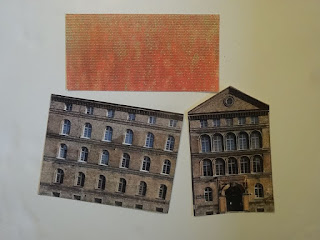
 Originally I had thought about making the structure so that the roof and the upper floor were separate pieces that could be lifted off, but eventually decided that it would be easier to have the room layout of the different floors off board and build the Post Office as a single piece. I looked for some good colour photographs of the Post Office online, and I was able to do some photo editing to create two files that could be printed off and glued to a structure made of foam core. For the roof detail, I scanned a sheet of Faller embossed cardboard with a red tile pattern that was left over from a project I did decades ago.  The roof itself was made of cardboard from cases of Lipton Iced Tea, and some 3D detail added to the front of the building using 3mm thick cardboard which also supported the dormer above the main entrance. The final features were the chimneys and the downspouts located either side of the main entrance. 


Here are some pics of the construction in progress.

Here is the end result. The final dimensions are L 56cm x W 15cm x H 23cm. I also made two additional terrain bits to mark where the sappers had successfully breached the outer walls of the building.

With the main terrain feature now complete, it's time to work on some early war Germans, especially the support weapons that were used in the attack. More to follow.

Saturday, November 21, 2020

Encore Avec Les 10mm French

Another small batch of 10mm reinforcements for the French of 1870.
 

Nothing too original or surprising in this post - here are yet more 10mm French infantry for the Franco-Prussian War of 1870. The castings are from Pendraken. There are three bases of regular line infantry, and a single base of Chasseurs. 

Lovely castings from Pendraken, as always.
 

While these figures could work for a wide assortment of rules, I am currently working with 1 base = 1 battalion in mind for these 10mm figures, so this post includes enough figures to add another full line regiment and chasseur battalion to my French collection for the period. With that said, many rules are flexible when it comes to their unit scales, so this could just as easily be said to represent a line infantry battalion and a couple of companies of chasseurs...all depending of your flavour of game and scenario.

Chasseurs to the front!
 

Each division in the French Imperial Army of the era (before everything fell apart after Sedan) included a single battalion of Chasseurs, along with two brigades of infantry, each with (usually) two regiments of line infantry. 

The French Chasseur uniform - blue, trimmed with yellow - not as flashy, but still sharp!
 

The Chasseurs had different uniforms from their colleagues in the line regiments - no red baggy pants for them. Instead, they wore closer fitting blue trousers, matching the blue on their tunic and their kepi. The uniforms were piped in yellow, and they had green epaulets. Not quite as striking as the regulation uniform of the line troops, but still sharp, in my opinion!

View from the rear, showing the excellent detail on the packs of the French line infantry.

Ready to defend the Empire! Vive l'Empereur!
 

My 10mm French collection is growing at a slow-but-steady pace...now up to six regiments of infantry and two battalions of Chasseurs. Watch for more as the long winter of COVID looms...I may need a short break from the recent run of 10mm work, but overall, there are some big battles I would love to play with the group one day, and that will call for a lot more posts like this. Thanks for reading, I hope you are staying safe and sane, wherever you are!   

Friday, November 20, 2020

Steyr Armoured Cars of the SS Heimwehr Danzig 1939

 A project that developed out of the Bolt Action scenario for the attack on the Polish Post Office in Danzig is the Steyr ADGZ armoured cars used by the SS Heimwehr Danzig. I have come across a few blogs and videos on YouTube where gamers have just substituted some other German armoured car for the Steyrs, but that just doesn't cut it in the Conscripts.

The Steyr armoured car was developed in Austria in 1934 and used by their army and police force prior to Anschluss, They had a very distinctive look in that they are almost symmetrical front to rear. In fact, they had two drivers, one facing forward and the other rearward, so the vehicle can drive in either direction at full speed. The SS bought a number of them, some of which were used in Danzig. Later in the war, they were used in anti-partisan operations in the Balkans.


At the moment the only sources of Steyrs in 1/56 scale are on 3D sites like Shapeways, but those can be rather pricey once shipping is included. As luck would have it, a friend of mine had recently acquired a 3D printer, and he was interested in trying something different. He purchased a file for printing the armoured car online and, after some necessary modifications, printed off two for me for the total cost of $15, which included the cost of the file.

They assembled fairly easily, with some sanding here and there, and drilling out the holes in the wheels a bit larger so they would fit on the axles. 


 They were painted a basic early war Panzer grey, which was straightforward enough, but then came the problem of finding appropriate decals. The Steyr armoured cars used by the SS Heimwehr Danzig bore rather unique markings such as SS runes and skulls, but also names of various German territories that were viewed by the Nazis as 'belonging to the Reich' such as 'Ostmark', 'Sudetenland', and 'Memelland'. Again, while kits and decal sets for the Steyr exist in 1/72 and 1/35, they do not in 1/56.


Not having the ability of print water transfer decals, I resorted to printing them on paper with a laser printer. I started with the image above, changed the colour of the background to match the grey of the vehicles, and printed it off. I then cut out the parts that I wanted, sanded the backs to make the paper thinner, and glued them on the model with PVA. I am pretty pleased with how they turned out. 


If you are interested in more information of the Steyr ADGZ, follow the link below.

 https://tanks-encyclopedia.com/ww2/nazi_germany/Austrian_ADGZ.php

The next step is the construction of the Polish Post Office that will take center stage on the wargames table. More to follow.


Wednesday, November 18, 2020

Star Wars Legion: General Veers


Untitled


General Veers, a 1/47 scale figure for Star Wars Legion, from FFG. I started with zenithal highlights and spotlighting with an airbrush, acrylic glazes, then details and blending with oils.


Untitled


I used FFG’s Imperial Uniform as the base for the clothing, and Vallejo German Camouflage Dark Green (which I originally bought for WWII German helmets) for the helmet and armour.


 Untitled


Untitled


For the game Star Wars Legion, points-wise Veers is a cheaper commander than, say, Darth Vader. His rules also make him good for coordinating vehicles with his troops and such. Fitting for someone who is, arguably, the most successful ground commander in Star Wars lore.