Showing posts with label naval. Show all posts

Friday, October 2, 2020

Battle of Chemulpo Bay, February 9, 1904

Remote miniatures gaming on Zoom!

Last week I ran a naval war game on Zoom, using Gridded Naval Rules, by Bob Cordery. We re-fought the Battle of Chemulpo Bay, which occurred on 9 February 1904, at the start of the Russo-Japanese War: https://en.wikipedia.org/wiki/Battle_of_Chemulpo_Bay

A Japanese squadron attacked Russian forces trying to break out from a neutral Korean port into the open seas. Frederick and Dallas managed to navigate their Japanese forces remotely, against my doomed Russian force.

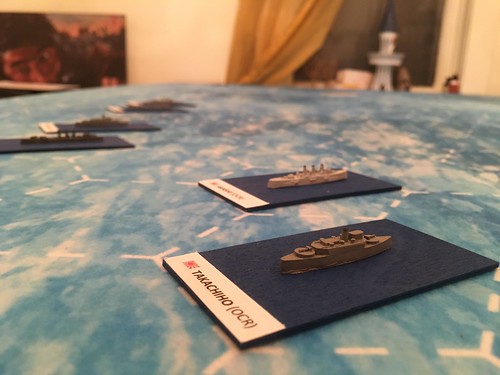
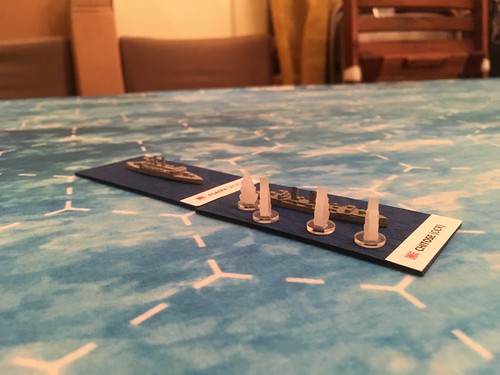
All the ships are 1/2400 scale resin models from Panzerschiffe. The beautiful cloth battle mat is from Cigar Box (you can have them add hex grids of various sizes).

Below, the Russian cruiser Variag, accompanied by the old gunboat Korietz.

Untitled 

The superior Japanese forces, arrayed into 4 divisions: 3 divisions of two cruisers each, and a torpedo boat division. Frederick ran two cruiser divisions: the lead division with the most modern warship leading, the armoured cruiser Asama; he also ran the Naniwa and the Niitaka. Dallas ran the third cruiser division (the Akashi and the Takachiho) and the torpedo boat division.

Untitled 


Untitled 

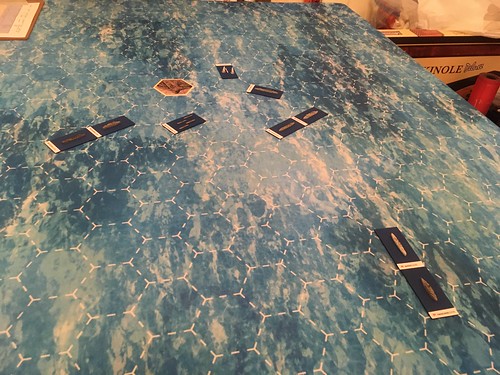
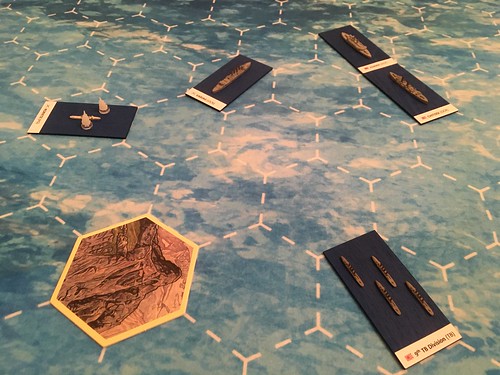
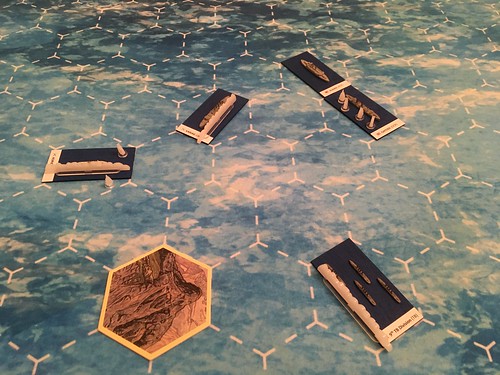
Initial setup of the opposing forces.

Untitled 

The initial stages of the battle, as the Japanese move to try a squeeze play on the Russians, who in turn used the cover of an island to shield themselves from gun fire as long as possible.

Untitled 


Untitled 

First blood to the Japanese, as the Korietz started taking long range hits from the leading Japanese cruiser, the Asama.

Untitled 


Untitled 

Just before the climax of the game. The Russians tried to cross the Japanese T, but were beat to the punch. Meanwhile, the Japanese torpedo boats had set up a nice deflection shot on the Variag.

Untitled >
In only ONE turn of furious shooting and torpedo fire, both Russian ships were sunk, all the Japanese torpedo boats were sunk, and the Chitose took serious damage. A decisive Japanese victory!

Untitled 


Untitled 


Untitled 

Historically, the Japanese forces turned away from the Russians, to keep them at long range. 

However, in the game Frederick and Dallas played the Japanese forces very aggressively, getting into knife fighting range with their 8" and 6" naval guns, and torpedoes. (Click on the maps below to enlarge them.)


I used multiple cameras, but the hand held iPhone SE did most of the work, zooming in and out upon different parts of the battle area.

The simple rules and hex grid allowed the players to maneuver pretty easily. I look forward to trying out these rules again.

Friday, August 11, 2017

Battle of Hudson's Bay - 1697


Every year I spend one month in Winnipeg and I always look forward to it because it gives me a chance to play a few games with the Conscripts. Last Thursday, KevinH, DaveV and ByronM were kind enough to come to my suite downtown to push some sail ships miniatures.

I offered a choice of two scenarii: Battle of Cape Ortegal -1805, or Battle of Hudson’s Bay - 1697.  The guests chose the latter, which was fitting given that it’s Canada’s 150th birthday. The battle happened on September 5. A British squadron’s primary mission was to replenish Fort Nelson and to get out of the Bay as it was already late in the season. The Hampshire was a military vessel and her mission was to escort the merchantmen. The Dering and the Hudson’s Bay were merchant vessels property of the Hudson’s Bay Company. It could be assumed that it was difficult to repair a ship in the Hudson Bay and, in September, there is not much time left to get out of the bay before the sea freezes. The British merchant ships probably wanted to avoid any damage to make sure they could get out of the Bay before being caught in the icepack. On the French side, the Pélican was under the command or Pierre Le Moyne d’Iberville, a warrior who led a very adventurous life. I encourage you to read his bio on wikipedia. A recreation of the battle was done by Radio-Canada (in French) back in 1967-68. I remember watching this show as a wee little kid and it might have sparked my interest for sail ships.

There is also a diorama displaying the four ships involved in the battle at the Royal Canadian Artillery Museum in Shilo. Unfortuntely, these cool ships can not be played with.


We had time to play the scenario twice and d’Iberville’s ship was sunk in both cases, proving that he was either an outstanding sailor or a lucky bastard. I would argue for the former.


The Pélican, coming strong on the British squadron. "Men, we'll bag those Brits before our second coffee of the morning." Alas, it was not to be. All models are from GHQ.


Here is a shot at sea level. Everything seems calm and quiet, but not for long...


The Pélican, in the upper right corner, shot by all the British ships in the same turn. Aouch!


Blub! Blub! Blub! D'Iberville probably would not survive having to swim to the shore in freezing water, while avoiding polar bears. All in all, it was fun to watch.

In any case, it was great to visit with the Conscripts again and I'm grateful to them for taking an evening to share my passion for sail ships.

Monday, January 23, 2017

Byron's 5th, 6th, and 7th Painting Challenge Submissions

Another week has past, and with it some additional submissions to Curt's Analogue Hobbies Painting Challenge.  After a super slow week last week due to being sick, I had a whole pile of things ready to go live, so even though it was one week, I had 3 submissions.

Entry #5 - Small Scale Items

This entry was a whole bunch of random small scale items.

Great War Naval Forces - 1/3000 scale Dreadnoughts

Having done WW1 in 28mm over the last few years, I started reading more and more of the history around the whole war.  The naval aspect of the war caught my fancy and I thought, why not do some ships to have some small games at some point.  After all, you don't need that many ships, and how hard could they be to paint?

Well, the answer to that last part is, very hard if the sculpts are not great.  I got my ships from Mick Yarrow Miniatures after searching around for a while, they had decent reviews online and they were cheap so I figured why not.  Well, they are cheap, but the quality is pretty horrible.  They must be using molds made around the same time these ships were really sailing!  Some were concave, some had bubbles, some were missing guns, some were 2-3mm thick and others were 7-10mm thick, making them all very inconsistent.  They were CHEAP though, so I guess I should have known.


Epic 30k - Death Guard (Part 2)
 
Thanks to Greg, I got corrupted and dragged along with the Epic 30k madness that he has descended into.  Luckily, I have only gone partially insane as I am sticking to one single faction and a small force of them at that.  

 
Team Yankee 6mm - American Reinforcements
 
I have been working on both Russian and American forces to do Team Yankee in 6mm, but basing them on a desert conflict so that I can use them for a cold war gone hot like Team Yankee or for theoretical or real gulf war games.  Anyway, I have most of the forces done already, but needed some additional infantry, so banged off another unit of American infantry and their transports, which have to be one of the ugliest transports ever invented.

Entry #6 - Arena Rex 35mm Beasts


My friend Steve picked up a new game a little while back, and after seeing the quality of the figs I just had to get some to paint up.  That game is Arena Rex, a 35mm skirmish Fantasy Gladiator game. The figures are just stunning up close, the detail is amazing.  The only down side, the price is stunning as well!

The rules are available for free though, and I tried a game with some proxy figured with Steve before I ordered my own.  It is one of those rare games that looks super simplistic at first glance, but has an amazing amount of depth hidden in it.  It has strategy, tactics, resource management, and more all rolled up in to what seems at first glance a simplistic smash-up gladiator game.


 I wanted to really sell the Arena setting of the figures, but also make them usable for other things, so... I picture that arena with a sand based floor I wanted to do something sand based.  However, not wanting something as mundane as simple flat sand, I decided to try some cracked earth effects in parts of the base.  I picture this as areas where the arena got wet from blood, thrown beverages from hecklers, or hell where a horse or bull took a leak, and now the sand and mud has dried and cracked.  I also added just a few tufts of dead grass to the base to add a bit more interest.  Again, probably not seen in a lot of arenas, but if you picture a weekend circus and then time passing before the next big event it is possible that some small tufts find a way to grow. especially around the dried cracked mud that has extra nutrients added.  That's my story anyway, I don't care if you buy it, I can live with it.


Onto the beasts themselves, I did almost everything with my new toy (a Harder & Steenback Infinity CRplus 0.15mm airbrush, which is AMAZING to work with!).  The beasts were done with black primer, then white or grey zenithal highlights and then many thin layers of glazes for colours.  I know Greg's eye is twitching over all that, but it really was simple and fast.  WAY faster than trying to get the same results with a brush.  I honestly believe that the Scorpion was done (primer - clear coat) in less than an hour of work time, and by brush I know I would have spent 4-6 hours to get the same effect.

These guys are HUGE, they are 35mm scale, the WW1 infantry
model is a 28mm scale fig to show just how big these are.

Entry #7 - 28mm Napoleonic Artillery Teams

Last up for the week was three teams of French Napoleonic Artillery all done on some huge diorama-like stands (60mm wide x 120mm deep).
Four years ago now, I started doing some French Napoleonic figures as a promise to Curt that I would at least try doing something historical for my first painting challenge.  It was a unit of Perry line infantry, and my first exposure to painting the madness that is Napoleonic uniforms! UGGG!

Four years later I finally have enough done to think about some small games!  Something Greg and I will have to arrange sometime soon for the group.


Having completed some pretty big projects in the challenge lately, I am pretty tapped out, and will not have much ready to go live this coming week, so I may not have another update here for a few weeks (other than the theme week entry).

Monday, July 25, 2016

Cape St-Vincent - 1797

During my yearly sojourn in Winnipeg, I had the chance to share some wargaming time and a few beer with the Winnipeg Conscripts at Casa Violago.

I had prepared a scenario featuring some of my sailships: On the morning of 14 February 1797, a British squadron of 15 ships of the line met a Spanish fleet twice as numerous, with 27 ships of the Line, including the giant Santissima Trinidad. The HMS Victory was present, as well as Nelson, but on a different ship, and he was only Commodore at that time but was ready to break the rules of traditional sea warfare. The scenario was played with fewer ships: the British had 9 ships and the Spanish, 14.

The victory conditions for this scenario were as follow: If, after 10 turns,
- The Spanish have no ships striking colours and 1 or more British did strike colours, the Spanish win an outstanding victory.
- 1 to 5 Spanish ships stroke colours, the British win a marginal victory.
- 6 or more Spanish ships stroke colours, the British win an outstanding victory.
Historically, the British did capture 4 Spanish ships.

The rules I used are a modified version of "Trafalgar" that I called "Trafalgar Redux". The original rules are great, but things start to slow down drastically when more than 5 ships per side are used. In "Trafalgar Redux", many elements of the rules are heavily simplified to allow battle with more ships. For example, the saving throw is replaced by additional boxes on the ship. Firepower is integrated into the ship display sheet. Modifiers for firing are limited to 3 and ships can fire at any point of their movement without penalty. If ships are in column, then they all move as one unit, etc.


From left to right:  Sylvain, shaking dice for the sake of shaking dice, Byron and Brian, proud Admirals of the Spanish fleet. The orderly British column, at the bottom, starts its steady progresion towards the Spanish mass of ships, partly visible in the upper right corner of the table.

Kevin and Dave, the British Admirals, smiling confidently as they listen to all the special rules favouring the British side: Spanish roll for morale for each critical hit they receive, British reroll "1"s when firing, etc. etc. etc.

The HMS Britannia, a first rate, 100 gun ship, follows the HMS Victory towards the thick of the Spanish fleet.  The Spanish Admirals are ready to give the order to fire.

First smoke! Furious exchanges of cannonballs resulted in one Spanish ship already striking colours, as indicated by the red marker. Spanish ships can be identified by their yellow stickers at the back of the base while British ships feature white stickers.


A Spanish ship on fire. But this is nothing compared to the HMS Britannia that will later be lit like a torch. Fire from the hull of HMS Britannia will eventually spread to all the masts and the crew had to work frantically for many turns to get everything back under control. Many good sailors were roasted during the event.

Brian assessing the situation from a standing position. The British are rigorously maintaining their line as directed.

Nelson, who was only Commodore at that time, was the only one allowed to break the British line in order to accomplish something awesome. Here HMS Conqueror (playing proxy to HMS Captain) blocks the line of incoming Spanish ships.

Exchanges of fire are getting more numerous as the the fleets are penetrating each other. I just love how the smoke puffs translate the intensity of  the battle at this point. It is also possible to visualize who is shooting who.
 
The last turn played. Five Spanish ships had striken colours at this point, meaning a marginal victory for the British. From the point of view of the umpire, the whole battle was very fun to watch, and I think that if the modified rules did not work perfectly, they worked satisfactorily.

In retrospect, I think that the Spanish fleet should have put the big heavy hitters at the front, and give the officers a more central position in the fleet, to help with the morale checks. With the special rules, the Spanish had to keep their ships very close to each others in order to recuperate from striking colours.

No real sailors or miniature ships were hurt during the game, but the same can't be said about the above bottles, only remain of some delicious beer brought by the participants.

Thanks to the Winnipeg Conscripts, Brian, Byron, Dave and Kevin, who were kind enough to push my little ships around the board for a whole evening!

Friday, August 14, 2015

Spanked! - Naval Action in the War of 1812 (1/1200 sailing ships)

When war was declared with Great Britain in 1812, the American navy was just in its infancy at that time and had nothing comparable to the numerous and large ships of the Royal Navy. However, the Americans built strong frigates crewed by aggressive sailors and commanded by competent captains. In duels, the American frigates would usually win.Well, not this time...

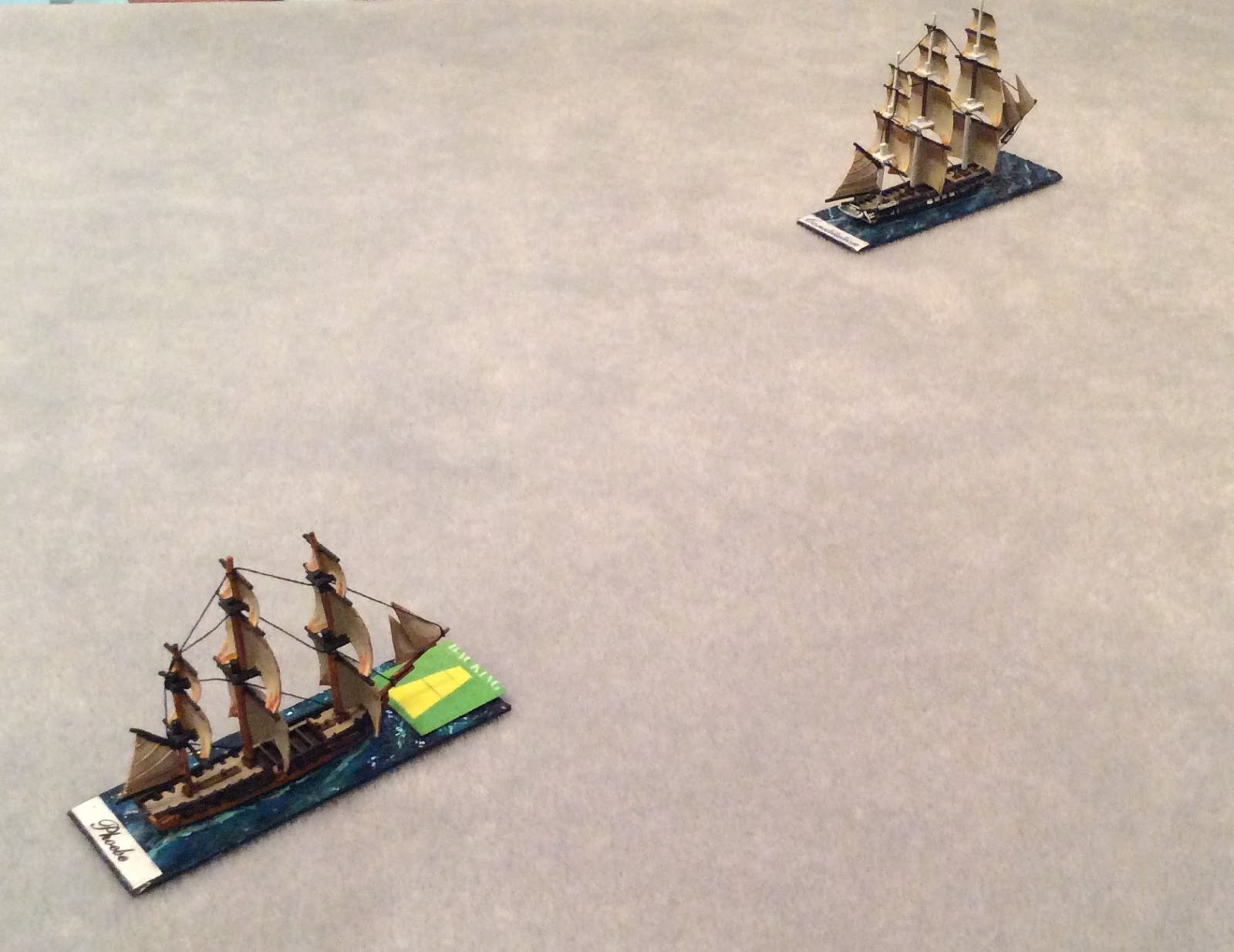
This scenario pitted the USS Constitution against HMS Guerriere in the the famous action off the East coast on 19 August 1812. The rules were a modified version of Trafalgar called Trafalgar Redux and the models were from GHQ.


Captain James Richard "Kevin" Dacres was in command a British 38 gun frigate while Isaac "Sylvain" Hull was steering a strong 44 gun American frigate, specifically built to outperform British ships of the same size.


Sent to investigate, the USS Constitution just identified a British intruder in American waters. Get ready for battle!


The American crew displayed excellent seamanship, keeping a good distance from the enemy, avoiding being shot by moving out of the British firing arc...


... while shooting at the masts to slowly, but surely destroy the enemy's sailing capacity. Everything was historically correct so far.


Then, a series of unfortunate events happened. The American crew failed a first maneuver test, a tacking maneuver, which meant that the USS Constitution was now stationary in the water and the British had the wind in good position. To understand how humiliating the situation was, a comparison is necessary. It's like, for a WW1 soldier, to fall head first into the barbed wires he was about to jump, with the butt sticking out in  the air. Another test for being taken aback resulted in heavy damage to the fore mast and severe casualties among the crew. The British frigate took this opportunity to do a stern rake which resulted in ruinous damage to the hull.


Stunned by how ridiculous the situation was, the American crew probably panicked because, in the next two turns, two more maneuver tests, just to turn the ship back into the wind, also failed. The American butt was still sticking out in the air and the British frigate, after an impeccable tack maneuver, came back for more spanking, right into the stern again. Ouch! Ouch! Ouch! This time, the USS Constitution took two critical hits, one resulting into a blaze which reached the reserve of black powder, which exploded, virtually wiping out the crew. The ship was still afloat, but the crew had had enough and the captain had to strike colours.

The rules work quite well for one on one battles, but I think I would like to give captains maybe one or two re-rolls per game to alleviate series of bad rolls.

Thanks Kevin for coming and trying this scenario. The outcome was not historical at all, but it was interesting and funny.


Friday, August 7, 2015

Battle of San Domingo 1806 (1/1200 sailing ships)

Yesterday, Dave and Byron came to my suite for a game pitting British against French ships of the line. The battle of San Domingo was the last fleet battle of the Napoleonic wars to be fought in open waters. Of notice, H.M.S. Canopus was commanded by captain Francis Austen, brother of Jane Austen. One of the most dramatic event of the battle happened when the Northumberland moved between the Impérial and the Superb to protect the flagship. Some shots from the giant French ship went right through the Northumberland and into the Superb. But, of course, wargaming was to redefine history.

At the beginning of this fleet engagement, British and French ships had to be set at least 15cm apart (measured from base to base, not main mast to main mast) in their respective deployment zones, to reflect the scattered aspect of the fleets too rapidly engaged in battle. This included ships from the Louis squadron entering on the map, that will enter the board with a die roll equal to or lower than the current turn number. This made it very difficult to form battle lines.

The objective of the French squadron was to escape to the South West corner with as many ships as possible. The objective of the British squadron was to intercept as many French ships as possible. Victory would be measured as follow:

5 French ships escape    Great French victory
4 French ships escape    French victory
3 French ships escape    Marginal French victory
2 French ships escape    Marginal British victory
1 French ship escapes    British victory
0 French ship escapes    Great British victory

The rules used were a simplified version of "Trafalgar" that I call "Trafalgar Redux". It speeds up the game considerably by halving the number of dice to be rolled.

The British squadron commanded by rear admiral Byron Duckworth, recognizable with the white name tags at the stern, duly proceeded to intercept the  French ships of Dave Leissègues, with blue name tags.

As I forgot my sea board at home, Byron was kind enough to bring his own sea mat from "Dreadfleet". Oddly enough, the mat and the ship bases matched perfectly.

The Agamemnon, a 64 gun third rate, the smallest ship on the board, sails toward the Impérial, the largest ship, with 120 guns. Is this wise?

BOOM! BOOM! After the smoke dispersed, it appeared that the Agamemnon lost two masts while the Impérial was still in good order. Both sides were mostly aiming at the masts at this point of the game, trying to reduce the speed of the opponent's units.

Soon, French and British ships were engaged in ferocious gun exchanges.

The British were able to get the second squadron on board. Rear Admiral Thomas Louis was eager to join the fight visible in the distance.

 Meanwhile, in the central melee, a few ships collided with each other and became unable to fire.

The three ships under the command of Louis, including the 80 gun Canopus, are getting closer and closer. Will this sceal the end of the French attempt to disrupt British commerce with the colonies? What could prevent a British Victory?


Wait a minute. What is this? A wind dial? So the wind changed direction. So what. I beg your pardon? It allowed a French victory? How is that even possible?

Because of the way the ships were positioned, after the wind changed direction, it became impossible for the British vessels still able to sail to catch three of the escaping French ships, including the giant Impérial. This was enough for a French marginal victory. This kind of event could only happen during the age of sail.

 Here are a few images of the last turn of the battle. A British ship caught fire during an exchange of volley causing the reserve of black powder to explode. The ship survived though.

Louis was just about to join battle. One of the French ships, invisible because she is completely wrapped in smoke, caught fire during an exchange of cannon balls, stroke her colours down as a result, then blew up because of an explosion.

On her way to the edge of the table, after an incredibly graceful tack manoeuver, the Impérial sunk a British ship trying to block her way. French sailors can cause surprises sometimes.

The action in the middle, on the last turn played. The black smoke shows were are located the two ships on fire, that eventually exploded without sinking. So the final result was: 3 French ships escaped, 2 were captured, 1 British ship was sunk and 2 were badly damage. The destruction and carnage felt very satisfying to the host.


Byron and Dave, discussing the outcome of the battle after it was decided to end the game when the result became obvious. The mat really made the whole experience look good. I'll definitely need to get one. Again, thanks Byron and Dave for playing this scenario.