Showing posts with label Republican Rome. Show all posts

Tuesday, August 20, 2019

Mega-DBA - The Battle of Dertosa, 215 B.C.E.

The Battle of Dertosa, also known as the Battle of Ibera, was fought in the spring of 215 BCE on the south bank of the Ebro River, across from the town of Dertosa. Historically, a Roman army, under the command of Gnaeus Cornelius Scipio Calvus and Publius Cornelius Scipio, engaged a similarly sized Carthaginian army under Hasdrubal Barca.

The Romans, under Gnaeus Scipio, had established themselves in Hispania after winning the Battle of Cissa in 218 BC. Hasdrubal Barca's expedition to evict them had ended in the defeat of the Iberian contingent of the Carthaginian navy at the Battle of Ebro River in 217 BC. Barca launched another expedition in 215 BC 215 BC. He moved north with some 25,000 foot, 4,000 horse and 21 elephants. The Scipio brothers massed 30,000 infantry and 3,000 cavalry to bar his path at the Ebro River. Hasdrubal's objective was to defeat the main Roman field army so that he could cross into Italy while still maintaining Carthaginian control of Spain. The Scipio brothers likewise aimed to defeat Barca in open battle to prevent his crossing into Italy and to break his grip on the Iberian Peninsula

(Historically, the Carthaginians defeat at Dertosa cost them a chance to reinforce Hannibal at a critical juncture, and the Romans gained the initiative in Hispania.)

***

Dallas mentioned how it's been awhile since we have done some big battle De Bellis Antiquitatis ("Mega-DBA") ancients, and Conscript Sylvain is in town for a little while, so Thursday night I organized an ancients game based upon the above-noted battle, using DBA version 2.2. For years DBA was popular locally, then people drifted away. I know of only one local person who has painted up a DBA 3.0 army. DBA 2.2 is what our group is familiar with.

Each side ended up having the equivalent of 2 complete DBA armies. We had an historical "matched pairs" encounter: the defenders were 15mm DBA Late Carthaginians, the attacking Roman side was  represented on the table by 15mm Polybian Roman armies of the mid-Republic. The figures were painted by Conscripts Frederick and Kevin (each had painted a Roman and a Carthaginian army; Kevin's figs now reside in my collection).

Brian played the C-in-C of the Carthaginians, Hasdrubal Barca, and Dallas was his subordinate (his brother-in-law, maybe?). Each Carthaginian general had an Elephant stand; Brian was hoping for great things from his elephant, nicknamed "Sparkles" for the evening. Frederick was the C-in-C for the Romans, playing Gnaeus Cornelius Scipio Calvus ("Scipio the Elder"), and Sylvain played his subordinate, his brother Publius Cornelius Scipio ("Scipio Junior"). Each C-in-C wold roll both command dice each bound, and apportion the dice as they saw fit between themselves and their subordinate.

Who would win this dust-up between two consuls of the Roman Republic and one of the scions of the uber-rich Carthaginian Barca clan?

***

The Battle

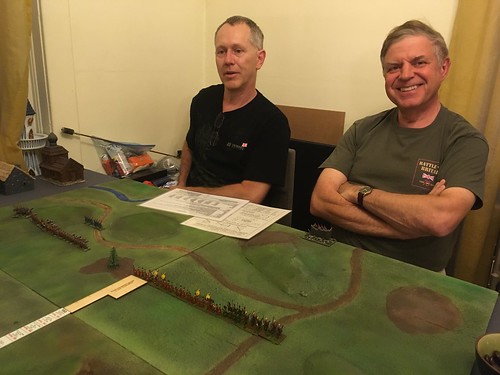
Below, looking southward, Dallas and Brian can be seen sitting behind their deployed Carthaginians.
(Click the pictures to enlarge.)

Untitled

Below, Sylvain and Frederick sit behind the northern edge of the table, overseeing long lines of Roman legionaries.
Untitled

Below, closer shot of the Romans commanded by Frederick's Scipio the Elder.

Untitled

Below, looking west, both sides drawn up for battle. Frederick rolled a "1" and a "4" for PIPs. He kept the 1 as his forces were in one long line.

Untitled

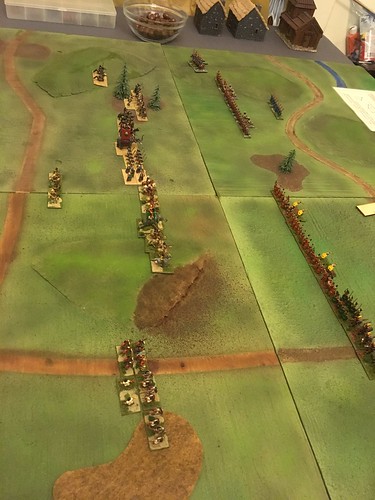
 The Carthaginians advance north.

Untitled

Both sides sent some cavalry to try and flank the forest seen to the far west.
Untitled

The Carthaginians divide their forces to meet the Roman lines.

Untitled

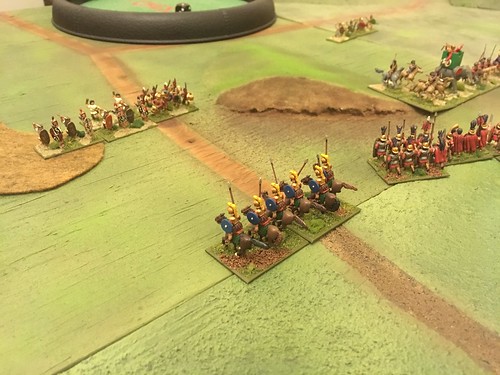
The Carthaginian eastern edge was held by Spears in ranks on the road, with their flanks anchored by a small cliff, and some light infantry in the marsh. The Roman cavalry declined to attack and these small forces shouted invective at each other all game.
Untitled

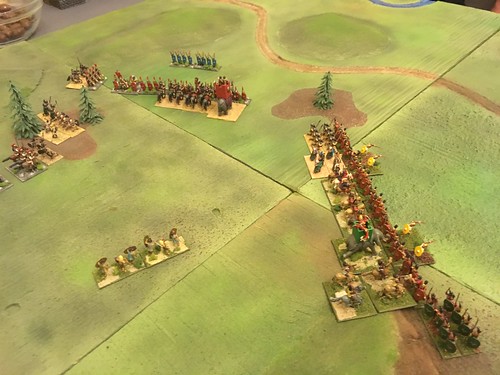
The Carthaginians seized the initiative by advancing to contact all up and down the lines. To the west some Roman Blades are in danger from the flanking Light Cavalry.
Untitled

To the west, some Roman Cavalry fence with Carthaginian Auxilia in the woods. Neither side could afford to lose because of the placement of friendly units; of course their battle was a draw!

Untitled

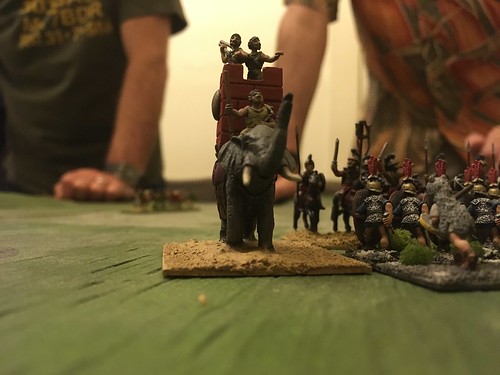
Sparkles ground down a stand of Blades and moves forward to fill the gap!
Untitled

Some of Brian's Celtic Warband  tried to kill the Roman C-inC, but were slain for their trouble. The rest of the Carthaginians bounced off the Roman shield wall.

Untitled

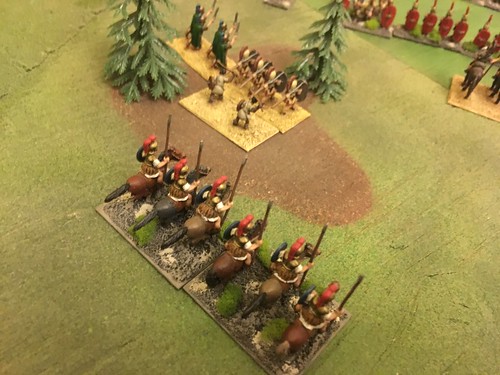
With the support of some friends, the Roman Cavalry rode the Carthaginian Auxilia down.
Untitled

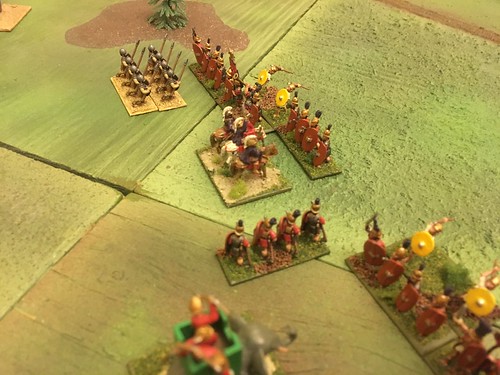
Below, some legionary Blades try and flank the Carthaginian sub commander. Dallas rolled hot and drove off his attackers.
Untitled

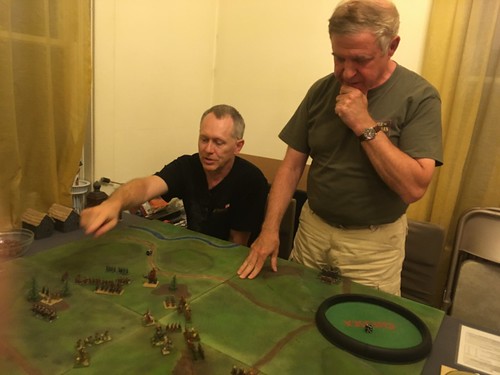
Below, the Roman players contemplate their next moves.
Untitled

Brian's  Barca, with the help of Sparkles, tried to nail another stand of Blades who had Psiloi support, but the Romans' swordplay and javelins forced off their attackers.

Untitled

Below, in response, some Roman Triarii move to face off against Sparkles. The rest of the line advanced on the Carthaginians, pushing back Barca's stand, and destroying another stand of Cav.

Untitled

Below, a panorama of the land south of the Ebro River, at this final point of the battle.
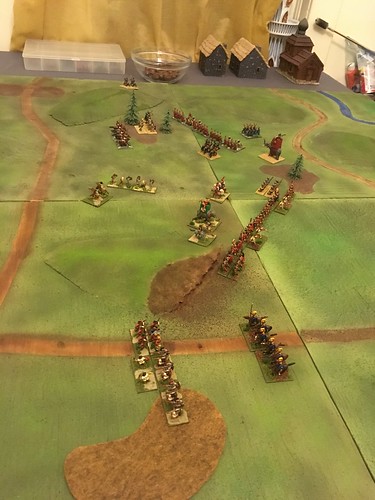
Untitled

The casualties below tell the tale. Barca's half of the army reached its breaking point, and the Romans had only lost one stand so far. The Carthaginians threw in the towel, and, as in history, the Carthaginians retreated off the table. Barca somehow survived, leaving the Scipios the masters of the field.
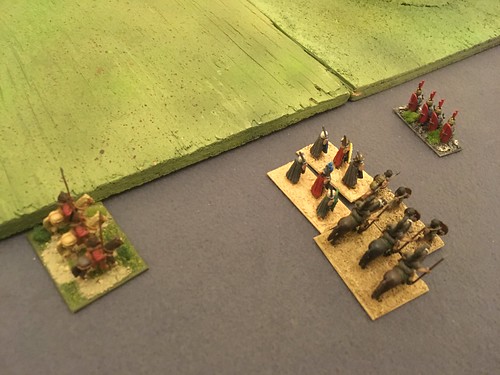
Untitled

All agreed that it was fun to push around figures using DBA again. I have both Scythian and  Mongolian armies ready for cleanup and painting. The Scythians in particular would make great opponents for the various Greek Hoplite and Roman armies several of us have.


Hordes of the Things

The game prompted me to finally finish off the shields on some HotT Wood Elf Knights that I painted up and have been playing for years. Cheated a bit, using some Eldar Harlequin decals and some thin green glazes to make the white look like it was painted a little unevenly on the shields.
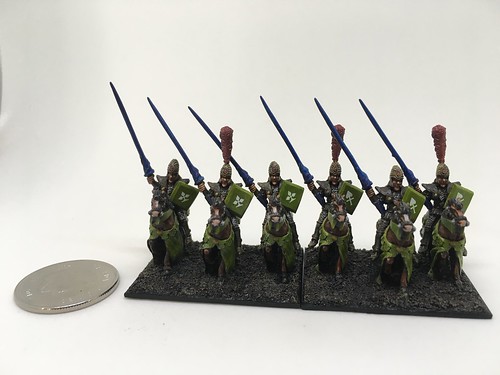
Untitled

It's a fun army, with figures from Chariot Miniatures. It's constituted of: 1 x Magician General, 1 x Magician, 1 x Hero, 2 x Knights, and 4 x Shooters (and a Toad for when the Magicians' magic goes horribly wrong).

Untitled

Sunday, February 15, 2015

Mega-DBA: Heraclea, 280 B.C.E.

De Bellis Antiquitatis ("Of the Wars of Antiquity") used to be a big thing around these parts. The game, a fast-play set of ancients rules, was used for a long-running, twice-yearly tournament held at Conscript Frederick's school. I was taught the game by former North Dakotan gamer DougR, over drinks at a sci-fi convention. Over the years it provided me hours and hours of fun,

The game has languished for a few years now, going out of print for awhile, and undergoing a seemingly interminable re-design prior to the recent release of its latest, 3rd edition. Conscript Kevin was musing about how much fun we used to have playing DBA and its big-battle incarnation, "Mega-DBA".

Accordingly, for last Thursday night I organized an ancients battle (using DBA version 2.2) based upon the Battle of Heraclea, a big dust-up between the Roman Republic and a coalition of Greeks.

***
Scenario: The Battle of Heraclea
Date: July, 280 B.C.E.
Location: Heraclea, Basilicata, southern Italy
Commanders: King Pyrrhus of Epirus (Greek/Epirote alliance) and Publius Valerius Laevinus (Rome)

Pyrrhus has landed in Italy, in support of the city of Tarentum, who were in conflict with Rome. Pyrrhus had a mixed force of ~35,000 men: Greek/ Macedonian and allied heavy infantry (phalangites, hoplites, and hypaspists), war elephants, Thessalonian cavalry, and archers and slingers from Rhodes.

After hearing of Pyrrhus' arrival in Italy, the Romans mobilized eight legions with auxiliaries, totaling about 80,000 soldiers. They divided these forces into four armies. Three armies defended Rome and otherwise marched against the Samnites, Lucanians, and Etruscans, to ensure that they did not ally with Pyrrhus. One ~45,000-strong army, under the command of Publius Valerius Laevinus, marched to Tarentum (after plundering Lucania on the way).

Pyrrhus decided to fight the Romans on a plain near the river Siris, between Pandosia and Heraclea. Pyrrhus took up position there and waited. Before the fight he tried to treat with the Romans, who denied his request. The Romans entered the plains on the right of the Siris river where they set up camp.

Who would win this conflict between Legion and Phalanx?

***

Each side ended up having the equivalent of 4 complete DBA armies. With a ground scale of one inch = 100 paces, and one figure casting representing 250 men, each side had around 40,000 troops spread across a few miles of front! We didn't have some of the exact historical units, but the following is our approximation of the forces involved:

Greek Alliance:
  • Seleucid (the C-in-C, run by BillC): representing Pyrrhus riding with his Companion cavalry, sarissa-armed phalangites, lighter troops, and the elephants he brought from Africa
  • Later Hoplite Greek (run by Dallas): representing a spear-armed infantry phalanx and supporting troops of Greek allies
  • Later Hoplite Greek (run by me): representing some more spear-armed infantry and their supporting troops
  • Early Spanish (run by MikeF): representing Greek colonists and others rising up against Rome

Republican Rome:
  • Polybian Roman (C-in-C, run by Frederick): representing the manipular Roman army, drawn up in three lines (triplex acies of legionaries formed into Hastati, Principes, and Triarii) consisting of small units (maniples) of 120 men, arrayed in chessboard fashion, giving great tactical strength and flexibility
  • Polybian Roman (run by Keegan): representing more legionary Roman forces of the period
  • Carthaginian (run by Kevin): representing Rome's non-citizen armed forces (an ala or an actual foreign allied force fighting under their own system; fun fact, Carthage was a Roman ally at this time)
  • Carthaginian (run by Devin): representing more non-citizen forces or allies

Below, Frederick and Bill loom over the table, after initial deployment. The photo looks south along the length of the Siris River valley. On the left (east) bank of the river are drawn up the two Polybian Roman forces. Further to the left/east, the Carthaginians are coming up from reserve. Near the north and south ends of the table are fords; everywhere else the river had to be crossed with restrictions as to movement and formation. Small units of Roman light and regular cavalry are set up by the far, southernmost ford. The Greeks refused their left (northern) flank. Dallas' Greeks are set up in a long line along the road. Further to the south are my Greeks and Bill's Seleucids in columns. Mike's lighter forces are set up to contest the distant river crossing. A forlorn hope of Greek and Seleucid light infantry are on the west bank of the river, staring at thousands of Roman legionaries. 


Camera Roll-1260


In the centre, Bill's Seleucids and my Greeks in column. My Greeks were modified and painted for me by TimP (of Gisby fame). All the spears are hammered wire.

Camera Roll-1261


Dallas' Greeks in line; his figs are owned and painted by Conscript Brian, who replaced all the spears with hammered wire and hand painted all the shield designs.

Camera Roll-1262


The Greek and Seleucid light infantry stare down legionaries across the river.

Camera Roll-1263


The battle started with light forces coming into contact under a hail of sling stones and javelins.

Camera Roll-1264


Though putting up a stout resistance, the Greek light infantry in the centre were overwhelmed by their more numerous opponents.

Camera Roll-1265


Camera Roll-1266


However, their sacrifice allowed the balance of the Greek forces to form line of battle.

Camera Roll-1267


The Greek elephants were unleashed early, in an attempt to roll over the Roman commander, Publius Valerius Laevinus.

Camera Roll-1268


However, the Romans held fast in the face of their monstrous foes, forcing them to recoil and panic. Both elephant units were destroyed! The phalanxes moved forward to plug the resulting gap.

Camera Roll-1269


To the north, Greek cavalry demonstrated against the Carthaginian light horse as the rest of the Carthaginians advanced to the river.

Camera Roll-1270


To the south, the Romans failed to cross the river, but a couple of stands of Roman cavalry tied up a quarter of the Greek forces. In the centre, the battle lines got confused as forces collided, recoiled, and surged back into battle. In the distance can be seen a fight between Greek and Roman cavalry, between the lines of Dallas' hoplites and some legionaries.

Camera Roll-1271


The cavalry from both sides in front of Dallas were all destroyed. The left end of the Roman legionary formation started to turn in as the pike and spear phalanxes ground ahead.

Camera Roll-1272


After losing 12 stands (1/4 of their entire force), the Romans called it quits. However, the Greeks had  in return lost 9 stands!

Camera Roll-1273


Below, a photo of the butcher's bill: all the units removed from play.

Camera Roll-1274


Though the Romans got stalled by the river, the game was very close. Frederick also claimed a well deserved moral victory in the destruction of the Greek elephants. In retrospect, forcing the Greeks to deploy just a little further away would have allowed more of the Roman and Carthaginian heavy infantry to get into the fray.

Historical note: The phrase "Pyrrhic victory" is named after Pyrrhus, whose army suffered irreplaceable casualties in defeating the Romans at both Heraclea and at Asculum in 279 B.C.E.,  during the Pyrrhic War. After the latter battle, Plutarch relates in a report by Dionysius:
The armies separated; and, it is said, Pyrrhus replied to one that gave him joy of his victory that one more such victory would utterly undo him
***

The only ancients gaming we usually do on a Thursday night is the odd Gladiator skirmish game. It was fun to see everyone caught up in a large game involving such substantial forces. The game also went much faster than if we had used a more complex set of rules, such as DBMM, Hail Caesar, or Clash of Empires. Looking forward to playing more ancients in the future!