Showing posts with label great war. Show all posts

Friday, September 24, 2021

28mm Great War Auto-Car Machine Gun Carrier from 1st Corps

This model had been on my radar for some time as an addition to my Great War Canadian force. The Autocar machine-gun carrier, while ultimately just a footnote in the development of armoured forces in the Great War, was a uniquely Canadian innovation and a neat-looking supplement to a wargames army.

Raymond Brutinel, the architect of the Armoured Autocar (and incidentally, one of the main drivers and tacticians of Canada's machine gun service) was an ex-French Army lieutenant who emigrated to Canada and made a fortune in mining stocks. He kept up an interest in military affairs, too - particularly as related to the machine gun. On the outbreak of the Great War, Brutinel contacted Sir Clifford Sifton, a wealthy Ottawa businessman who served as a cabinet minister in Laurier's government, to put forward his idea of creating a force of machine-gun-armed armoured vehicles. Sifton thought this was a capital plan indeed and resolved to raise the money to create this unit for Canada's armed forces.

Sam Hughes, Minister of Militia and Defence, approved the plan on 13 August 1914 (!) and Brutinel decamped for the USA to find appropriate vehicles. These he found in New York City, in the form of two-ton trucks manufactured by the Autocar concern in Pennsylvania, and used by the American Express company as transport vehicles. The large sum of money contributed by Canadian business benefactors ($150,000) allowed Brutinel to contract with Autocar for eight armoured machine gun carriers, five support vehicles for carrying ammunition and supplies, a fuel and oil tender, and four unarmoured "roadsters" for officer use. Autocar itself contributed an ambulance. 

Brutinel then contracted with the Colt Firearms Company of Hartford, Connecticut for twenty Colt Model 1914 machine guns and accessories - sixteen to mount on the Autocars and four spares. While the Colt was a poor weapon, the superior Vickers gun was in short supply at the time. However, by 1918 the Colts had all been supplanted by water-cooled Vickers guns as shown on my model.  

The fully equipped Autocar weighed three tons and was powered by a 22hp flat-twin water-cooled engine mounted under the driver. Top speed was 15mph. The armour plating was a mere 5mm thick and hardly bulletproof, despite the representations of the Autocar firm. The two machine guns were mounted along the centre of the rear compartment, and bins along the periphery carried 12,000 rounds of ammunition.

Its service history was somewhat mixed. By the time the 1st Canadian Motor Machine Gun Brigade reached the Ypres salient in June 1915, terrain conditions were not conducive to vehicles at the front lines. Brutinel changed tack and innovated a new role for his machine guns - indirect barrage fire. In this he was quite successful and eventually, he was appointed to Corps Machine Gun Officer, having control of all heavy machine guns in the Canadian Corps. 

By January 1918 Brutinel considered the Autocars obsolete and Sir Arthur Currie, Corps commander, endorsed his proposal to remove their armour and relegate them to a transport role. But before that could be done, the Germans launched the Kaiserschlacht offensives and the Autocars did yeoman service in zipping here and there to support the hard-pressed British troops. This brought a reappraisal of the value of the Autocars in "mobile warfare", and the unit served admirably in the Hundred Days campaign that ended the war. Four of the armoured Autocars survived the war. Two were returned to Canada in 1919 for possible use in quelling civil disturbances such as the Winnipeg General Strike. One of these disappeared after being sent to Winnipeg. The other was eventually used as a training vehicle for a time, and ultimately accessioned into the collection of the Canadian War Museum in Ottawa, where it can be seen today.

I quite enjoyed building and painting this model from 1st Corps, although the customer service I received was pretty poor. At first, there was no acknowledgement of my order - just an email from Paypal confirming my payment. After ten days or so I sent messages with no response - eventually I got a "yeah it's been sent" message through Facebook. However, when the order arrived, it didn't include the crew models shown on the 1st Corps site - instead of the standing crew member, I got a second gunner. Emails and Facebook messages asking about this discrepancy have not received a response. So - great models, lousy service. Disappointing, because I think a previous order of some Curteys Miniatures knights from them had come through fine. Oh well.

As noted, the model is great - resin body with metal guns, ammo boxes, coolant canisters, and wheels. The driver is cast in metal as one piece with his bench which makes for easy painting access to the cab. There are a couple of armour plates in resin too but despite there being no instructions included, assembly is easy enough to figure out from reference photos.
 

This 24-page book is an invaluable resource for information on, and many photos of, the Autocar. It's available from Service Publications for only $10CAD. Highly recommended.

Sunday, June 13, 2021

Great War 28mm Highlander Command

Back at it again after a time away from the brushes... these wee lads had unfortunately languished half-completed for far too long. They are, of course, the 1914 Scottish Command pack (B104) from Great War Miniatures.

I have a load of mono-posed early-war Highlanders from Foundry, but since they never made command figures in Highland rig I had to cast about for some from another manufacturer. This is unfortunately a "tall order" (heh) nowadays, for the Foundry Great War range (advertised in their catalog at the time as "26mm models") are unfashionably undersized by 2021 standards.

So, I decided to take the figures I could find nearest in size and style, and do what I could to shrink them, which is to say, not much. I filed down their metal bases to paper-thinness and based 'em the same as their Foundry comrades, but they're still noticeably bigger. Oh well.

They do look cool though. In the pack you get two rifle-toting sergeants, one officer with a cane, and two with revolvers. The officers wear a mix of kilts and trews with puttees, with Glengarries all round. I painted the kilts and trews in a quasi-Black Watch sett so hopefully the lads will go easy on me if they're ever fielded as a unit that sported a different sett.

Of course their other gear is pretty much standard Imperial/Commonwealth kit so they can fit in most anywhere.

Here they are with the rest of the platoon. I would say this command pack was fun to paint, and they were, but I'm so glad I upgraded my brushes before attempting the tartan. The superfine Kolinsky sables worked a treat.

Well that's it for now, hope everyone's staying safe and getting vaccinated.  

Monday, September 7, 2020

Expanding the Aerodrome - More 1/72 Great War Aircraft

So I've built and painted a couple more 1/72 aircraft - this time a Pfalz DIII and a Bristol Fighter - both from Ukrainian model manufacturer Roden. These two kits were on sale at a local toy shop for 25% off - not bad. But they did end up needing a bit of extra work to be usable.This was probably more about the builder than the kit. But more of that later.

The Pfalz was actually a pretty straightforward build - with one exception (alluded to in my previous post) - NO PILOT!!! But no problem, my order of Wartime Miniatures 20mm pilots from Asymmetric Wargames had arrived with eight metal 20mm pilot figures and one of them slotted straight into the cockpit.

According to the super-helpful 600-page reference book "German Aircraft of the First World War", Pfalz Flugzeug-Werke was founded in 1913 with the help of the Bavarian government. As a successor to the Roland DIs it built under license, Pfalz designed and built the DIII, powered by the "ubiquitous" 160hp Mercedes inline-six cylinder engine.

The DIII was armed with twin Spandau machineguns - on earlier models such as this, they were enclosed in the cowling, but the DIIIa mounted the guns on top of the cowl to facilitate easier servicing. The aircraft was highly rated by pilots and hundreds were built. Later on it was overshadowed by likely the best fighter of the war - the Fokker DVII - but the Pfalz was flown by its own share of aces, including Werner Voss, as well as the pilot whose aircraft I've built here - Leutnant Emil Thuy (35 victories and the Pour le Merite).

The kit went together without too much difficulty, except for the landing gear , which had to be scratch-built from wire after the flimsy kit parts broke. I also didn't rig the 'plane as it seems fiendishly difficult to do and wouldn't last on the table anyway!  

The second kit I finished was this Bristol F2B Fighter, sometimes known to its pilots as the "Brisfit". Somewhat of an oddity, being a two-seater, but the model enjoyed no little success, often due to German pilots thinking it was a single-seater and approaching from the six... only to be surprised by the rear-facing observer and his Lewis gun!


Like the Pfalz, the Brisfit kit was lacking pilot figures, so I used two of the Wartime Miniatures figures I got from Asymmetric Wargames in Italy. The markings on the aircraft are those of the plane flown by Captain Andrew McKeevor of Listowel, Ontario, a small town just northwest of Kitchener. McKeevor ended the war as the war's highest-scoring Brisfit ace with a tally of 31 victories. Of course Lt-Col. William Barker of Dauphin, Manitoba also flew a Brisfit in Italy, but scored most of his 53 victories in other planes, most famously the Sopwith Camel single-seater.

The kit gave me some issues, to be honest. The interwing struts were very thin and flimsy plastic and I quickly found that I wasn't going to be able to use them in assembly - although I tried. Instead I replaced most of the struts with wire I cut from paperclips.

Like the other 1/72 planes I've built, I've fitted these with pins to suit the flight stands.

Lt. Thuy about to get a surprise from Captain McKeevor's observer...

Anyway, two more for the aerodrome. Stay healthy everyone.
 

Thursday, July 23, 2020

1/72 WW1 Aircraft and Mini-Rant

Germans F-R: Fokker DR-1, D-VII, Roland C.II. Brits F-R: Sopwith Camel, SE-5
The lockdown produces some strange hobby obsessions, to be sure... in this case it's resurrected an ancient collection of 1/72 aircraft that (I think?) the group gamed with once, long ago. In digging around for some other hobby stuff I came across two unbuilt kits from that long-ago time, so on a lark I decided to build and paint them!
 
This is an Academy 1/72 Sopwith Camel, price on the box was marked "$3.25" (!) Flight stand is an excellent Forgeworld example that they produced for Aeronautica Imperialis, years ago.

Pilot with the Groucho Marx nose was sculpted by me, and provides the opportunity for a mini-rant. WHY OH WHY do plastic kit manufacturers produce model aircraft with open cockpits and NO PILOT??? It would drive me nuts to have to game with a pilotless Camel so I kneaded a pilot out of greenstuff. I know he looks terrible but at least there's a body in the cockpit.

Can't say much for the kit, I think it was less than 30 parts. Decal sheet was atrocious though - there was a decal provided for the tri-colour rudder but the colours were in the wrong order, so I had to paint it instead.

This is a Heller 1/72 Roland C.II. It's a pretty cool-looking aircraft that was known as the "Walfisch" (whale) due to its peculiar streamlined shape.

Unfortunately I'd already raided the decal sheet years ago to use the crosses on a Games Workshop Shadowsword, so I had to freehand the crosses on the Roland.

Heller included crew figures which was nice!

Roland pursued by SE-5. Did you know that Albert Ball's first aerial victory was over a Roland C.II? I'm sure you did...

Anyway, there's two more dusty old kits built up. Of course, building and painting the Camel and Roland reawakened my passion for Great War aviation so I promptly went out and bought three more Roden kits to build - another SE-5, a Bristol fighter, and a Fokker D-VI. They were 25% off even! We'll see how long they last in their boxes. I'm currently reading "Canvas Falcons" as well so that should keep the juices flowing.

Tally ho and stay safe!

Tuesday, March 29, 2016

LegioCon 2016: Retreat from Mons Great War Game

In addition to helping Conscript Greg with his amazing 40K game at LegioCon this year, I also volunteered to run an early-Great War game as well. Here is the description:

"The late summer of 1914 was marked by innumerable encounter battles between the German army and the French, Belgian and British forces operating on the Western Front. The game focusses on one of these battles between the Germans and the British Expeditionary Force leading up to the pivotal Battle of Mons in August 1914. Can the plucky "Old Contemptibles" withstand the furious onslaught of the German infantry, Uhlan lancers and even armoured cars? Or will the Huns triumph and drive the BEF back into the Channel? 28mm figures are supplied, rules are "The Great War" by Warhammer Historical.  6 players"


As noted, I used the old tried and true Warhammer "Great War" rules and the "Over the Top" supplement. The scenario we played was "Fighting Retreat", where the defender deploys in a box in the middle of the table, and must exit units off the table. The attacker can hold up to half his force (which totals twice the points of the defender's) in Reserve, and deploys the rest on the opposite short edge. reserves may enter the table on any edge but the defender's home edge.

The forces comprised, for the British defenders, a two-company battalion with three attached machineguns and an 18 pdr field gun. The Germans deployed two battalions each of two companies, plus three machineguns, a cavalry squadron of 12 Uhlans, and two armoured cars. They left one company, the cavalry, and the armoured cars in Reserve, and deployed the rest of the infantry. The models used in the game are all from Foundry's Great War range, with the exception of the Ehrhardt armoured cars (Barrage Miniatures) and the German and British commander models (Paul Hicks's Mutton Chop Miniatures). Some of the Germans were from the collection of our late friend Glenn Shott and I thought of the game as being somewhat in honour of him.

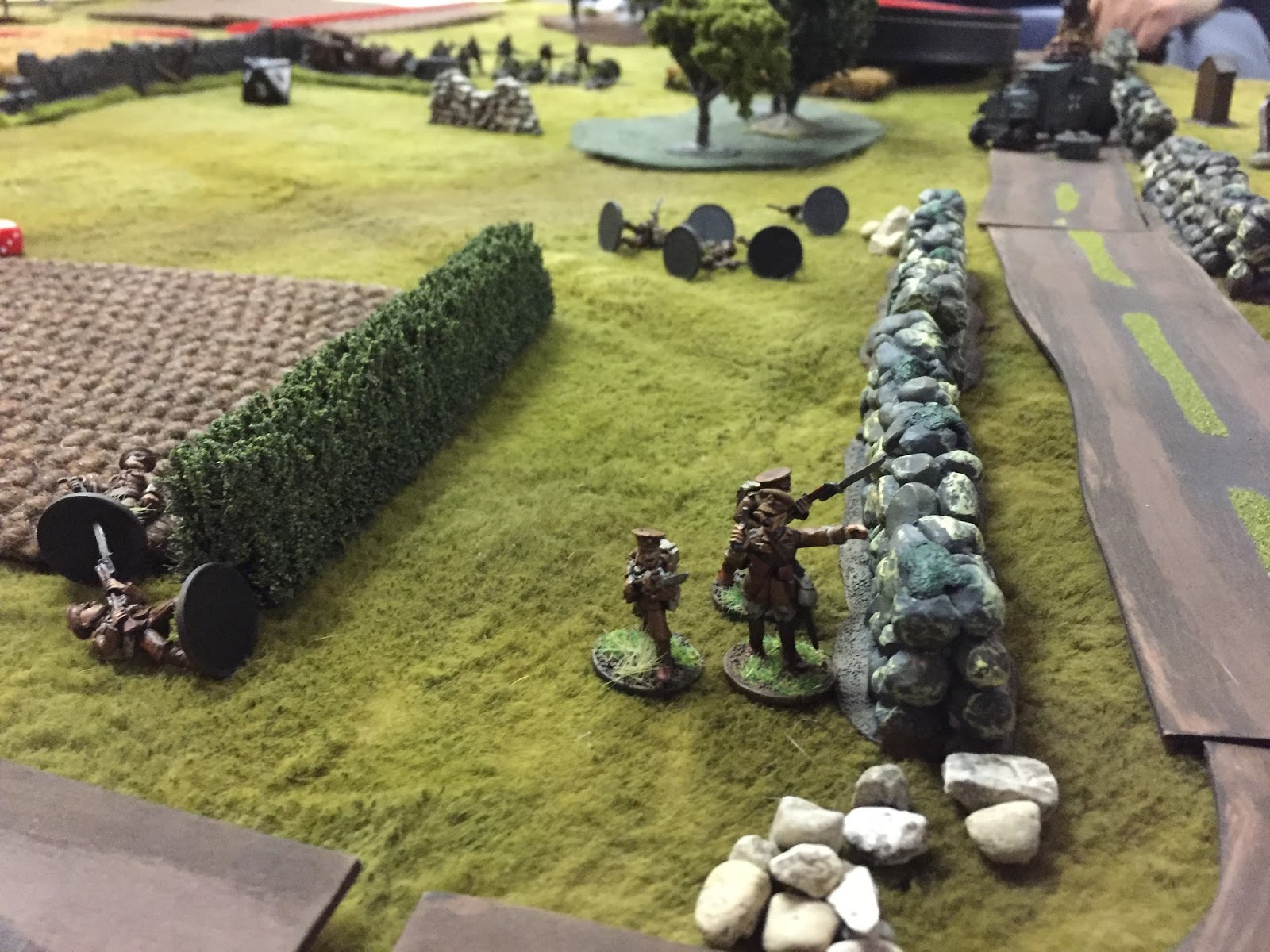
Here's the initial dispositions. German long-range machinegun fire was effective against the British artillery and machinegun. The grey wave rolled forward as the British prepared to withdraw from their positions towards the town behind them.

On turn 2 the Germans were lucky to have all their Reserves appear. An armoured car, an infantry company, and the Uhlans appeared on the British left, while the other armoured car swept in from their right. The unlucky armoured car was torched by "five rounds rapid" fire from the infantry behind the stone wall. Armoured cars in these rules are not proof against small arms fire by any means!

Infantry and Uhlans prepare to assault the British.

Uhlans sweep in! We had a bit of a moment here as we initially played the assault out, the Uhlans absolutely annihilating the British infantry. However, we forgot to apply the Overwatch rule from Over the Top (my fault). Once this was pointed out we rolled back the clock and replayed it with a completely different result - the Brits lit up the Uhlans on their charge and forced a Morale check, which the Uhlans failed, and they failed to make contact with the main British body. The Uhlan Squadron command troop did contact the British company command section, though, and destroyed it utterly.

The infantry company that beat off the Uhlans' charge made it off the table, the first of two units the British needed to exit in order to win. The battalion command group is in the foreground above; you can just see the other German armoured car in the background.

British infantry platoon charges and destroys a German platoon as more Germans approach from behind the woods.

Conscript Bill contemplates a strategic victory but a tactical defeat, as the second British unit escapes the Hun's noose. It was a fun game with much carnage, as you can see from the toppled casualties all over the field. I think the game looked good and the guys had fun - thanks to the Conscripts who came out to play, and Mac, a LegioCon regular who played with us as well.

This was a super-nice surprise for me at the end of the day, as I scrambled to clear away the game (I had to catch a plane for a work trip later that afternoon).

Garth of Maxx Collectibles, one of the prime movers behind LegioCon, said a few very kind words and awarded me this nice token of their appreciation for the games we put on at the Con. It was really nice to be recognized for our participation and I appreciated that a lot. Thanks LegioCon and see you next year!

Friday, January 15, 2016

Painting Challenge Entries so far... Update 1,2,3, and 4

Greg asked that all of us in the Analogue Painting Challenge that Curt runs, also post entries here in our own blog.  I have been forgetting to go that, so am posting one post with all of my entries to date in an effort to both catch up and to not flood the blog with 4 updates in one day.  So, here goes....

I started off with a good plan (The madness begins again...) and then like any plan, it started falling apart right away.  Oh well.

Entry #1 - 15mm Sherman Tanks (30 Points)


I started off the challenge with a really quick 1 day (3 hour) paint job on 5 plastic soldier company Sherman tanks for a quick 30 points. The tanks were really fast as I did some base highlighting on the primer level (airbrushed on black and white primer to pre-shade) and then a few thin coats of glaze consistency green through the airbrush.


I then only had to touch up details like the tracks, guns, and ports, and then use some pigment powders to weather them, and done.  Quick and dirty, but think they came out pretty well for the time spent.
Entry #2 - 'Nostalgia' from ByronM - Eldar Farseer 

This was a theme week entry for Nostalgia and I figured what better thing to do than something from my first 40k army.  Well, ok, maybe there was something better out there, but I couldn't think of anything so this is what I did!

The first Eldar army I did (I painted several over the last almost 20 years) was the Ulthwe colour scheme which is a simple black and bone scheme to show that they come from a world with very few living souls left. Black is always hard to pull off and have any depth showing so I actually painted the whole model a neutral grey and then layered in black ink in glaze coats. I still had to go back and add some hard edge highlights on the staff as the glaze method would not work on the really hard corners, but I think it worked out ok on the rest of the model.  


The gems were easy to get back to as well, since I had painted hundreds of them using a very simple 5 colour method from an old Eldar book, that I expanded to 7 colours.  After painting probably 1000 of them over the years I played Eldar, it was like riding a bike doing them again.

 
Entry #3 - French WW1 rifle sections (95 points)


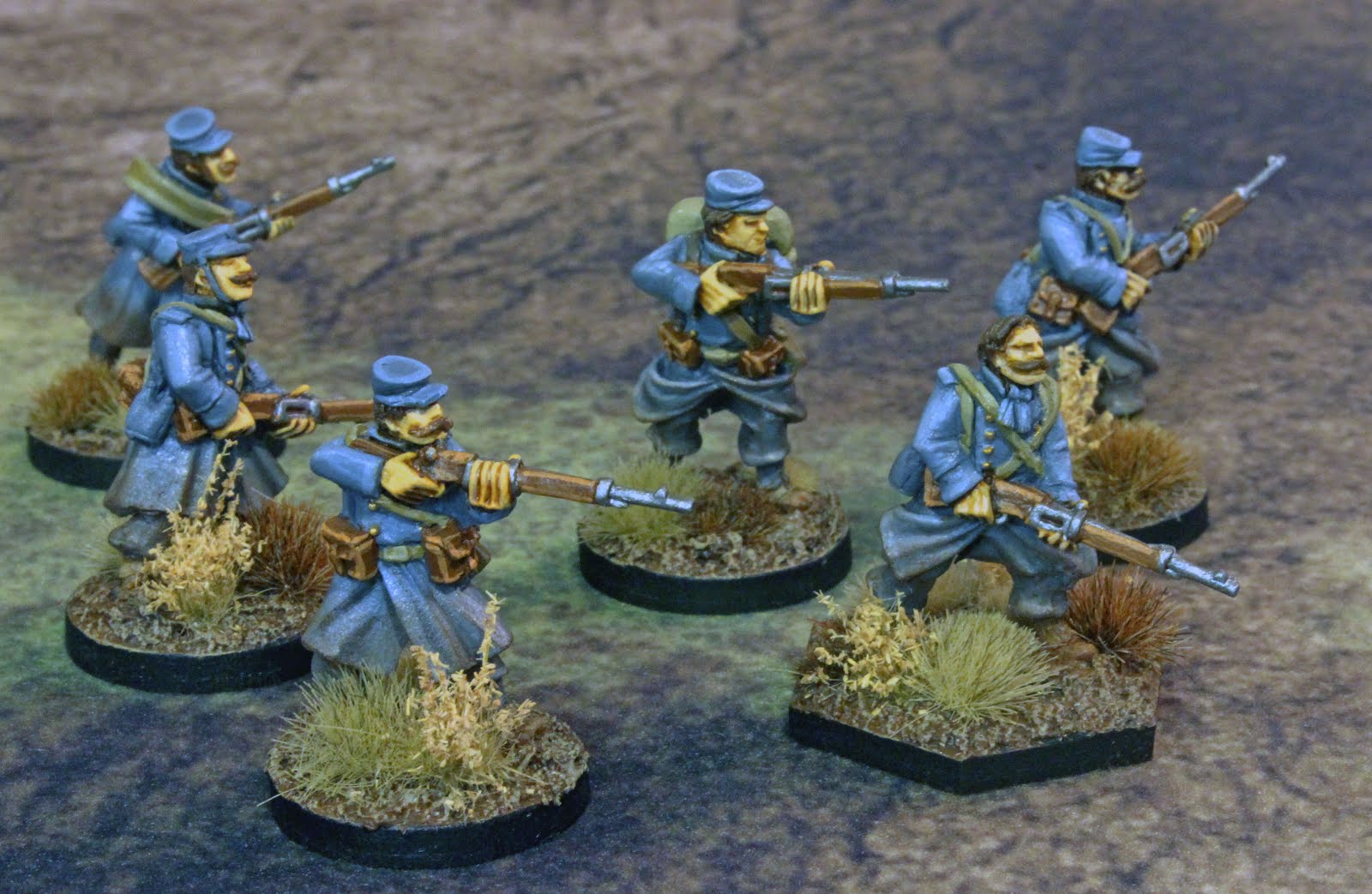
My third entry was an expansion to my World War 1 project to add some colour to the table.  This meant adding some really nice French early war figures from Renegade miniatures to my collection.


They were base coated with the airbrush and then the horizon blue was layered on with the airbrush as well.  I then moved into detail work to finish up.  I know many of our club have an aversion to airbrushes (looks at Greg!) but really, they make life so much easier for this mass kind of work.  The layers go on faster and more evenly than what I can do by hand, and it makes the job so much quicker.  Now if only I could do the super fine work that people like Angel Giraldez do with an airbrush!


Anyway, once the blue was done, it was onto some details and faces and then base work. 


I did the bases in my normal WW1 mud style but added a bunch of yellow and brown vegetation to show the effect of the gas being used in the area and to keep them different looking than my Canadians and Germans.

Entry #4 - Spectre 28mm Modern African Militia (100 points)

My latest submission was a group of modern militia that was a blast to paint.  Since there were so many different sculpts and each had a ton of character it was hard not to deep dive into the details.  I tried to keep each one different in colour but limited the overall details to the basics.  After all, a ton of these are needed for a game, yet each one is essentially cannon fodder.  I think points wise for a game I need about 40 of these, and only 4-6 professional or elite soldiers, so the time these guys can expect to survive on the battlefield is pretty close to 0.


I did have fun painting a NWA shirt, various hightop runners, baseball caps, and some bright coloured Crocs.

I especially had fun with things like people wearing khaki shirts or pants, but then putting on bright colour shorts of shirts, afterall anyone who thinks holding the gun sideways helps with aim would obviously also believe that baby blue is a good camo colour, right?


Overall so far...

In the last few years I have come to the conclusion that if I want to get things done I really can not try to paint every figure as a character, I need to paint more to a tabletop level. That means doing a bit more of a basic level for most troops instead of worrying about doing 3-5 layers in each colour and trying to treat each figure as a character.

The overall table top effect remains the pretty much the same, but it still feels kind of like cheating as these were not done to a high standard, and they kind of fall apart close up, but from table top level they look pretty good.

I still do some character figures trying to get as much detail as possible, but in general am trying a more "table top effect style" look than a painting competition style painting. I always marvel at how fast Dallas and Greg can get amazing looking armies done and am just starting to figure out that the trick is Don't try to paint everything as if it was going into a competition or to be looked at close up, paint it to be seen from the table top.... not something I am good at.

So, almost 4 weeks into the challenge and only 280 points done, which is a bit behind where I should be since it is only 3 months long this year.  I do have several things in the queue almost done though, so I should be ok.  Here is a sneak peak... 


Oh, and I will try to be better about posting updates here in the future.