Showing posts with label Ancient Greece. Show all posts

Monday, April 9, 2018

The Greeks first battle!

After working all winter on a huge number of Ancient Greeks, it was time to get them out and on the table for a battle.  While the plan is to run a few story driven battles with everyone at Dallas's place, I really wanted to get a handle on the rules in a one on one game before attempting a big multi player game.

So, last week with Dallas away and no regular game booked, Greg and I got together to hash through the "Hail Caesar" rules and make a go at a game.


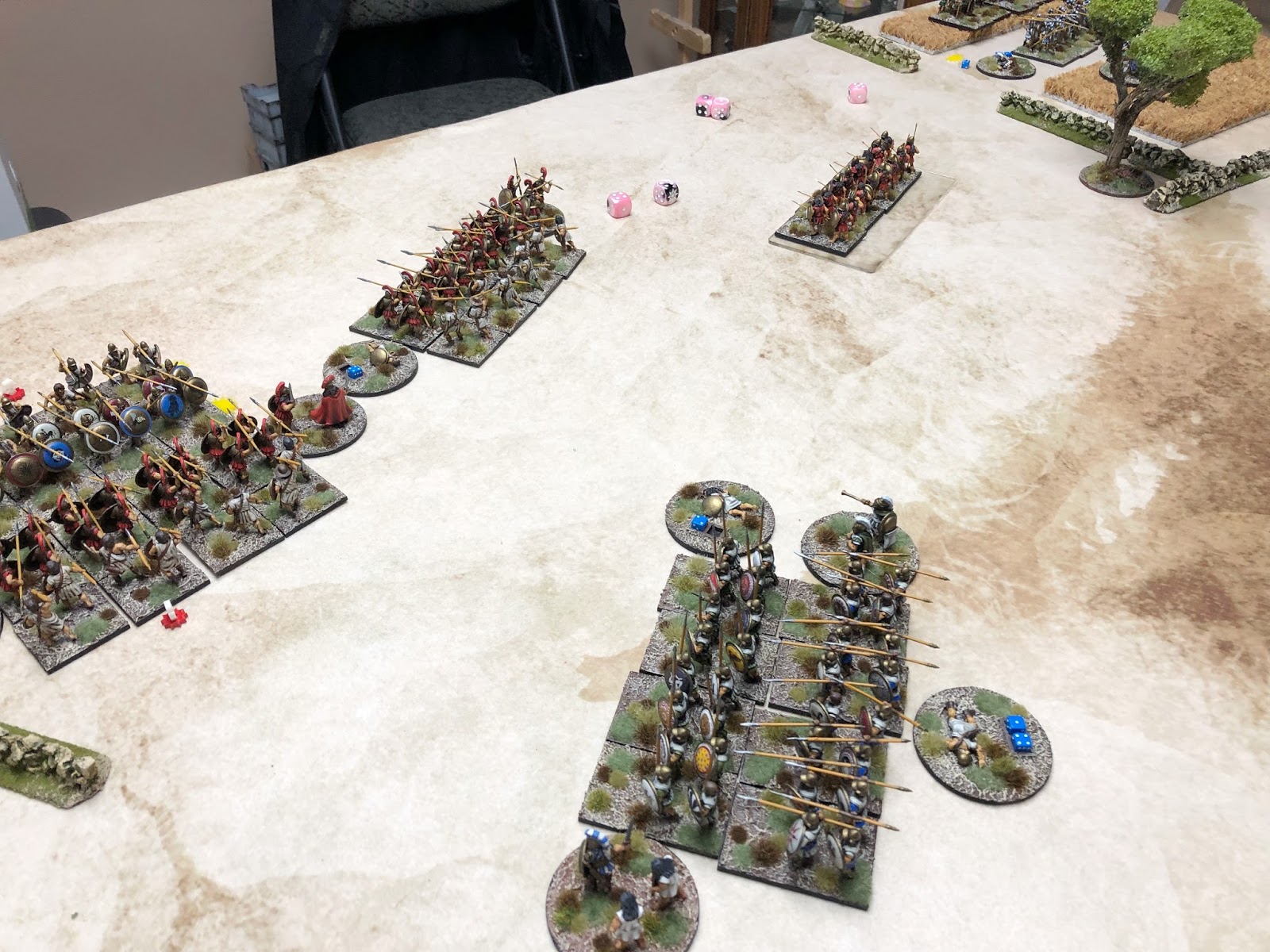
The protagonists were made up of a group of allied Greeks (Athenians and Thebeians) vs a smaller but more elite force of Lacedaemonians (more commonly referred to as the Spartans).   The battle field was made up of a lot of open desert area, with a well blocking part of one flank, and a few fields scattered around the edges.

Here are some of the Allied Greeks.


And here are some of the Spartans.


The rule set we used is "Hail Caesar" but most of you will be familiar with it in it's many other incarnations as: Pike & Shotte, Black Powder, or originally as Games Workshops Warmaster!


The game started with a lot of manuever failures on the side of the Athenians, with several units just refusing to follow orders. Eventually though after about 2 turns of minor move and adjust, both Greg and I went "Screw this!" and slammed our forces into each other.

 
 The initial hit, shattered an Athenian unit and sent it running right off the bat!  I suddenly worried that the game would be over in 30 minutes flat and that I would need WAY more units for a viable game.  However, it turns out that was a fluke, and things settled down after that with the push and counter push (literally) that phalanx combat was known for.

 Down the huge battle line, things went good and bad for each force.  In the center we fought forever back and forth, on the Spartans right flank they pushed through, and on the Athenians right flank, they pushed through.

The Spartan push on their right flank went well to start and then due to a number of bad rolls for them, and great rolls for 2 small skirmish units, they got held up for a large number of turns.  They finally routed the 2 small units but were too late to help elsewhere by that time.


On the Athenians right flank, they pushed forward, but then got pushed back 3 or 4 times all while shaken and disordered!  Amazingly they never ran and held several units in check for most of the game!  They finally did route near the end, but by then it wall in in the center for the game.


The center of the battle tied up at least 3 units on each side and was back and forth for a long time.  In the end both sides were battered, bruised, and shaken.  The deciding factor ended up being both of us throwing our generals in for a few extra combat dice, and units deciding to run due to being shaken and having to test on tied combats.


There were a lot of tied combats since phalanx units count anything that is a loss of up to 2 as a draw.  This meant that until they were shaken and had to test moral on draws, units just stood and took it!  The Spartans even more so, since they can reroll a failed armour save each turn so took far fewer casualties.
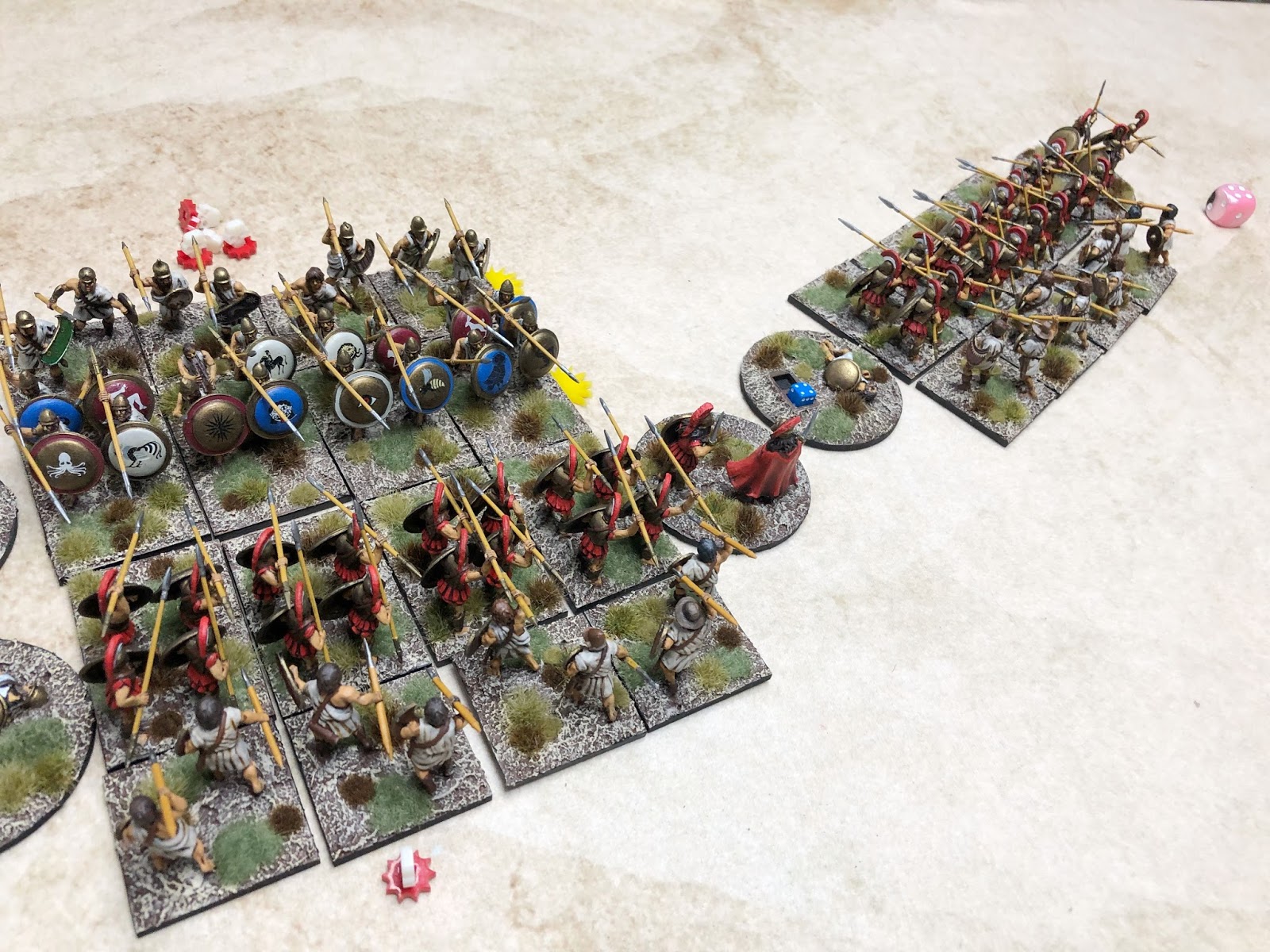

In the end, it was a blood bath with I believe 4 units left on the table!  Greg and I had a blast with it though, even though we made many mistakes, but figured them out along the way and corrected most of them.  We now both understand the rules much better and hope to have these figures out for a Thursday night game sometime soon!


Sunday, February 4, 2018

Byron's 8th through 10th enties to the painting challenge

Well, once again I have fallen behind in posting my entries, so I will get up to date with a brief(ish) post that has a picture or two from each of my last few submissions and links to the actual blog entries over on the Analogue Hobbies Painting Challenge site.

My 8th entry was a group of 6 30k Death Guard scimitar pattern jet bikes from the Horus Heresy era.  I fell in love with these when they were released a few years ago, but the price kept me from buying them until recently.  I didn't want to do a small squad of 3 since they would get wiped out too quickly like that, and I wanted them to have some staying power, so I did 6 of them.


The bikes are supposed to be mounted on the normal GW 50mm clear round flying stands and come with those along with 30mm tall mounting posts.  I thought both of these looked like crap with them, and the normal pill shaped bike bases are way to short at 50mm long for these behemoths.  So, I custom laser cut some 32mm wide (the new standard marine base size) x 100mm deep bases.


My 9th entry was some long discontinued GW forgeworld terrain that I picked up at a Baltimore Games Day 14 years ago that has sat in their boxes since then!!!
 
 
 I also included in that a unit of Greek slingers to add some range to my Greek forces.


Next up was a theme week entry for BFG (Big F!$%'ing Gun) where I did a pair of Siege-Automata for my 30k Mechanicum force.

Not only is the gun on this thing freaking huge, the whole thing is!  To give a sense of size the base is a 120mm x 92mm oval base and a marine barely reaches to his knee! 

Overall, I am very happy with how they came out, and I placed tied for second that week in the voting for best theme week entry. 
 
My 10th entry was an Archmagos for the 30k Mechanicum force and some more Greeks.

The Archmagos Prime on Abeyant for my 30k Mechanicum army now makes it an actual legal force to play with an HQ, so expect it to hit the tabletop soon.

Now that it is a valid force, I have also provided an overall picture of the army so far.  This is in-fact all that I bought initially to do for the force, but I have of course fallen in love with them, and more are on the way....
This time the Greek unit was more unarmoured Greek hoplites that I did as a support unit of mercenaries or militia for either side that I am working on.

This brings me back up to date as of the weekend, but there are 3 more entries up this weekend so expect another update early this coming week.  

Now we just need to setup a game to blood in the Mechanicum force!


Saturday, January 13, 2018

Byron's 4th, 5th and 6th Painting Challenge Submission - Greeks, Death Guard, and Mechanicum

I promised myself that this year I wouldn't fall behind in keeping up the cross posting to my home blog here for the painting challenge, but have once again fell behind anyway. So, time to catch up with everything...

The 4th entry I put in this year was more 30k Death Guard to expand my force so that I can contribute more to our groups rather large number of 30k battles that rage at least monthly.


I have a pile of figures to get done for the 30k version of the Death Guard this year, including several transports as my force so far has been almost exclusively foot based with little mobility.  However, before getting onto that, I needed to get some more infantry done (mainly due to the fact that I want to do all the vehicles at once and ran out of chipping solution so am waiting for it to arrive).
 
My 5th entry was a continuation of my Greek project, with another unit of Warlord (Immortal) Greeks, as well as a command stand of Spartans.


The command stand is made up of a pack of metal Spartans from Warlord and the quality is much better than the plastics.  Even though they still managed to get the arms wrong.  The arms are once again in a throwing motion, rather than an arm over spear for thrusting motion.  Oh well...  since I am painting a lot of the figures that have leather armour as if they had bronze armour, I probably shouldn't complain that much about things that most people wouldn't notice anyway.

I spent a lot more time on these, doing more blending and more highlights, which don't really show up in the pictures, but show up in person.  My thought being that the command stands will be looked at closer than the mass infantry units and should therefore get a bit more attention.


I then moved onto a second unit of Greeks, that are un-armoured.


Once again since they are meant for mass effect on the tabletop, they got a fairly basic treatment.  I blocked in colours, washed, then highlighted.  I then went over the shields and painted various colours and then applied decals.  After that is was a simple matter of basing them and they were done.  Not fancy but effective I think. 


So another 18 Greeks done, only about 200 left to go...


My sixth submission was more Castellax
Class Battle-Automata and a transport for my 30k Death Guard. The Castellax were armed with multi-meltas, flamers, and close combat saw blades this time around.


The bases are hand made using liquitex, cork board, cut up sprue, guitar wire, and copper pipe bits.  I tried to give them an urban rubble look without going overboard as I find a lot of cast resin rubble bases have too much on them and you wonder how the hell the model is moving through it.


I also kept with the blue glow as a colour accent to keep in theme with the last batch, even though I tend to think of melta as a red/orange glow.  My thought being that it just would look like more of the same base red armour colour if I did that.


Next up is a Death Guard Anvillus pattern drop pod that I had started doing up for this weeks "flight" theme just in case I didn't get the piece that I really wanted to get done completed.  I did though, so here is the drop pod as a regular submission.

The drop pod was painted the same way I have been doing all of my Death Guard vehicles, making heavy use of Mig products.  I base coated it black, applied chipping solution, painted the off white colour with an airbrush and then once dry wet it with water and started chipping the paint off.  It gives a completely random and organic look to it, you just have to give up control though as you can go light or hard on the brushing to control it a bit, but sometimes it just comes off in big sections and sometimes it sticks and you can't get any chips, so you just go with it.  I then apply decals and clear coat it, then come back with Mig streaking products and oil brushers and make it a mess with multiple different browns, blacks, and rust colours.  Apply a bit of each, let set for a bit, then use thinner or white spirits to spread it around and cause the streaks, or to clean up areas that got to much.


There we go, a whole pile of stuff off my painting shelf, but I already have it filling up again as stuff comes in to replace it.
 

Thursday, December 28, 2017

Byron's 2nd and 3rd submissions to the Painting Challenge

Over the past couple of days I submitted two entries to the painting challenge.

The first was one of the projects that I have most been looking forward too this year, the creation of a Mechanicum army for Warhammer 30k.   I have looked at the Mechanicum force for years and loved the overall look of the robot portion of the army, but just hated other portions of it.  Enter the Legio Cybernetica list this past year, which is a Taghmata variant that focuses on robots!  Hurray!  I can make a list with just robots, sign me up!


I love the bonkers look of these walking death machines, and love the fluff even more.  You basically have the masters of technology sitting on Mars thinking that people are idiots and machines are great, so lets turn people into machines.  Sounds great to me, since as a techie I trust machines far more than I trust people!

This is the first batch of two Castellax Class Battle-Automata that I finished and they are wielding the evil looking Dark Fire Cannon.  I honestly have no idea WTF they do in the game, I just got them because I liked the look of them!  Once the force is done and they have to go on the table, I will have to look them up.


Overall I am just aiming for effect on these and not going to spent a ton of time on them.  I am aiming for game pieces not show pieces so a lot of the details are not getting painted, I am using a lot of shortcuts and quick steps on them, nothing special close up, but hopefully good looking on the game table.

I wanted the entire force to look the same, especially with the reds which I find very hard to get looking right, so I have airbrushed all of the models I have all at once, and will be working on the details of small batches of them over the course of the challenge.  

I airbrushed all the reds, then touched up the black areas, then painted the silver.

At this point I was almost done, but something just didn't look right.  There was too much silver and red and no contrast colours.  While I had not planned on any other colours, I felt it needed something so went back and added some quick energy blooms on the weapons in a blue to white fade to try and show high energy expenditure. Not sure if blue / white was the right colour choice or not, but it certainly stands out, which is what I was looking for.


Last up was the bases.  I had initially planned a red martian soil base, but thought it would just blend the model to the base rather than making it stand out.  I changed it last minute to a simple black / grey rubble base using cork, bits of sprue, guitar string, plasticard, and liquitex.


Next up was another brand new force...
Last year I decided that I wanted to do something for this challenge that would allow me to get a bunch of figures done fairly quickly and bring a new era to our wargame group.  The era I chose was one that has interested me for a long while, Ancient Greece.


To start the force I chose to pick up a few boxes of the Warlord Spartans and Greeks, as they are readily available and fairly inexpensive.  I have always liked Warlord plastics so had high expectations...


Well, those expectations meant nothing, as Warlord has 3 different boxes of ancient Greeks, all advertised as different things, yet all of them have the same contents other than a few small character sprues and decals.  Worse, the poses are not varied at all, and have no thrusting arms only throwing arms or at rest arms. The sprues used by Warlord are old Immortal figures sprues and are not even really 28mm they are more like 25mm figures.  I have since ordered a few boxes of Victrix Greeks as they have proper thrusting arms and more varied poses, and will mix them into other units and try to keep the same height by leaving the Warlord figures on their bases and removing the Victrix from theirs.  I would strong recommend against anyone getting any of the Warlord Greeks.


I plan on using the Hail Caesar rule set, and while it recommends 40mm x 40mm bases for 4 figures, I decided on using 40mm x 60mm to allow for some extra ground work in front of the figures for both looks and protection of the spears.


Since I plan of painting at least 10 units of these over time, I wanted to keep the paint jobs very simple and quick so that I can get them done in a reasonable time.  Therefore these were painted by simply blocking in the colours, washing and then highlighting.  Super simple and basic table top level, as I don't know that you actually see much more than the shield from the front or some bronze and cloth from the back.  I will however spend more time on the command stands for the game as you will be able to see the figures there.


This first unit is 16 Spartans, of which probably 1/4 - 1/2 of my final force will be made up of.  I also plan on making heavy use of units from Athens and Thebes.

Sunday, February 15, 2015

Mega-DBA: Heraclea, 280 B.C.E.

De Bellis Antiquitatis ("Of the Wars of Antiquity") used to be a big thing around these parts. The game, a fast-play set of ancients rules, was used for a long-running, twice-yearly tournament held at Conscript Frederick's school. I was taught the game by former North Dakotan gamer DougR, over drinks at a sci-fi convention. Over the years it provided me hours and hours of fun,

The game has languished for a few years now, going out of print for awhile, and undergoing a seemingly interminable re-design prior to the recent release of its latest, 3rd edition. Conscript Kevin was musing about how much fun we used to have playing DBA and its big-battle incarnation, "Mega-DBA".

Accordingly, for last Thursday night I organized an ancients battle (using DBA version 2.2) based upon the Battle of Heraclea, a big dust-up between the Roman Republic and a coalition of Greeks.

***
Scenario: The Battle of Heraclea
Date: July, 280 B.C.E.
Location: Heraclea, Basilicata, southern Italy
Commanders: King Pyrrhus of Epirus (Greek/Epirote alliance) and Publius Valerius Laevinus (Rome)

Pyrrhus has landed in Italy, in support of the city of Tarentum, who were in conflict with Rome. Pyrrhus had a mixed force of ~35,000 men: Greek/ Macedonian and allied heavy infantry (phalangites, hoplites, and hypaspists), war elephants, Thessalonian cavalry, and archers and slingers from Rhodes.

After hearing of Pyrrhus' arrival in Italy, the Romans mobilized eight legions with auxiliaries, totaling about 80,000 soldiers. They divided these forces into four armies. Three armies defended Rome and otherwise marched against the Samnites, Lucanians, and Etruscans, to ensure that they did not ally with Pyrrhus. One ~45,000-strong army, under the command of Publius Valerius Laevinus, marched to Tarentum (after plundering Lucania on the way).

Pyrrhus decided to fight the Romans on a plain near the river Siris, between Pandosia and Heraclea. Pyrrhus took up position there and waited. Before the fight he tried to treat with the Romans, who denied his request. The Romans entered the plains on the right of the Siris river where they set up camp.

Who would win this conflict between Legion and Phalanx?

***

Each side ended up having the equivalent of 4 complete DBA armies. With a ground scale of one inch = 100 paces, and one figure casting representing 250 men, each side had around 40,000 troops spread across a few miles of front! We didn't have some of the exact historical units, but the following is our approximation of the forces involved:

Greek Alliance:
  • Seleucid (the C-in-C, run by BillC): representing Pyrrhus riding with his Companion cavalry, sarissa-armed phalangites, lighter troops, and the elephants he brought from Africa
  • Later Hoplite Greek (run by Dallas): representing a spear-armed infantry phalanx and supporting troops of Greek allies
  • Later Hoplite Greek (run by me): representing some more spear-armed infantry and their supporting troops
  • Early Spanish (run by MikeF): representing Greek colonists and others rising up against Rome

Republican Rome:
  • Polybian Roman (C-in-C, run by Frederick): representing the manipular Roman army, drawn up in three lines (triplex acies of legionaries formed into Hastati, Principes, and Triarii) consisting of small units (maniples) of 120 men, arrayed in chessboard fashion, giving great tactical strength and flexibility
  • Polybian Roman (run by Keegan): representing more legionary Roman forces of the period
  • Carthaginian (run by Kevin): representing Rome's non-citizen armed forces (an ala or an actual foreign allied force fighting under their own system; fun fact, Carthage was a Roman ally at this time)
  • Carthaginian (run by Devin): representing more non-citizen forces or allies

Below, Frederick and Bill loom over the table, after initial deployment. The photo looks south along the length of the Siris River valley. On the left (east) bank of the river are drawn up the two Polybian Roman forces. Further to the left/east, the Carthaginians are coming up from reserve. Near the north and south ends of the table are fords; everywhere else the river had to be crossed with restrictions as to movement and formation. Small units of Roman light and regular cavalry are set up by the far, southernmost ford. The Greeks refused their left (northern) flank. Dallas' Greeks are set up in a long line along the road. Further to the south are my Greeks and Bill's Seleucids in columns. Mike's lighter forces are set up to contest the distant river crossing. A forlorn hope of Greek and Seleucid light infantry are on the west bank of the river, staring at thousands of Roman legionaries. 


Camera Roll-1260


In the centre, Bill's Seleucids and my Greeks in column. My Greeks were modified and painted for me by TimP (of Gisby fame). All the spears are hammered wire.

Camera Roll-1261


Dallas' Greeks in line; his figs are owned and painted by Conscript Brian, who replaced all the spears with hammered wire and hand painted all the shield designs.

Camera Roll-1262


The Greek and Seleucid light infantry stare down legionaries across the river.

Camera Roll-1263


The battle started with light forces coming into contact under a hail of sling stones and javelins.

Camera Roll-1264


Though putting up a stout resistance, the Greek light infantry in the centre were overwhelmed by their more numerous opponents.

Camera Roll-1265


Camera Roll-1266


However, their sacrifice allowed the balance of the Greek forces to form line of battle.

Camera Roll-1267


The Greek elephants were unleashed early, in an attempt to roll over the Roman commander, Publius Valerius Laevinus.

Camera Roll-1268


However, the Romans held fast in the face of their monstrous foes, forcing them to recoil and panic. Both elephant units were destroyed! The phalanxes moved forward to plug the resulting gap.

Camera Roll-1269


To the north, Greek cavalry demonstrated against the Carthaginian light horse as the rest of the Carthaginians advanced to the river.

Camera Roll-1270


To the south, the Romans failed to cross the river, but a couple of stands of Roman cavalry tied up a quarter of the Greek forces. In the centre, the battle lines got confused as forces collided, recoiled, and surged back into battle. In the distance can be seen a fight between Greek and Roman cavalry, between the lines of Dallas' hoplites and some legionaries.

Camera Roll-1271


The cavalry from both sides in front of Dallas were all destroyed. The left end of the Roman legionary formation started to turn in as the pike and spear phalanxes ground ahead.

Camera Roll-1272


After losing 12 stands (1/4 of their entire force), the Romans called it quits. However, the Greeks had  in return lost 9 stands!

Camera Roll-1273


Below, a photo of the butcher's bill: all the units removed from play.

Camera Roll-1274


Though the Romans got stalled by the river, the game was very close. Frederick also claimed a well deserved moral victory in the destruction of the Greek elephants. In retrospect, forcing the Greeks to deploy just a little further away would have allowed more of the Roman and Carthaginian heavy infantry to get into the fray.

Historical note: The phrase "Pyrrhic victory" is named after Pyrrhus, whose army suffered irreplaceable casualties in defeating the Romans at both Heraclea and at Asculum in 279 B.C.E.,  during the Pyrrhic War. After the latter battle, Plutarch relates in a report by Dionysius:
The armies separated; and, it is said, Pyrrhus replied to one that gave him joy of his victory that one more such victory would utterly undo him
***

The only ancients gaming we usually do on a Thursday night is the odd Gladiator skirmish game. It was fun to see everyone caught up in a large game involving such substantial forces. The game also went much faster than if we had used a more complex set of rules, such as DBMM, Hail Caesar, or Clash of Empires. Looking forward to playing more ancients in the future!